

Bulk Freeze Dried Strawberries: A Buyer’s Field Guide
Bulk freeze dried strawberries look harmless.
Red pieces.
Lightweight cartons.
A clean sample bag.
Maybe a nice crunch when you taste the first piece.
Easy order, right?
Not quite.
Anyone who has handled fruit ingredients at scale knows the trouble usually starts after the sample stage. A sample can look beautiful because someone packed it carefully by hand. Bulk cartons tell the truth. The fruit either survives shipping, storage, mixing, feeding, and packing — or it does not.
We have seen buyers learn this the hard way.
A cereal brand approves clean strawberry slices, then receives cartons with too much dust at the bottom. A chocolate maker chooses a cheaper supplier, then finds the fruit carries more moisture than the coating system can tolerate. A pet food brand asks only for price, then spends two weeks chasing residue documents. A private-label snack company orders whole berries because they look premium, but the pieces crack during transit.
That is not a small issue.
That is money sitting in damaged cartons.
So let’s talk about bulk freeze dried strawberries in the way buyers actually need to talk about them. Not as a pretty fruit snack. Not as a generic dried strawberry. As a technical B2B ingredient that has to perform inside real production lines.
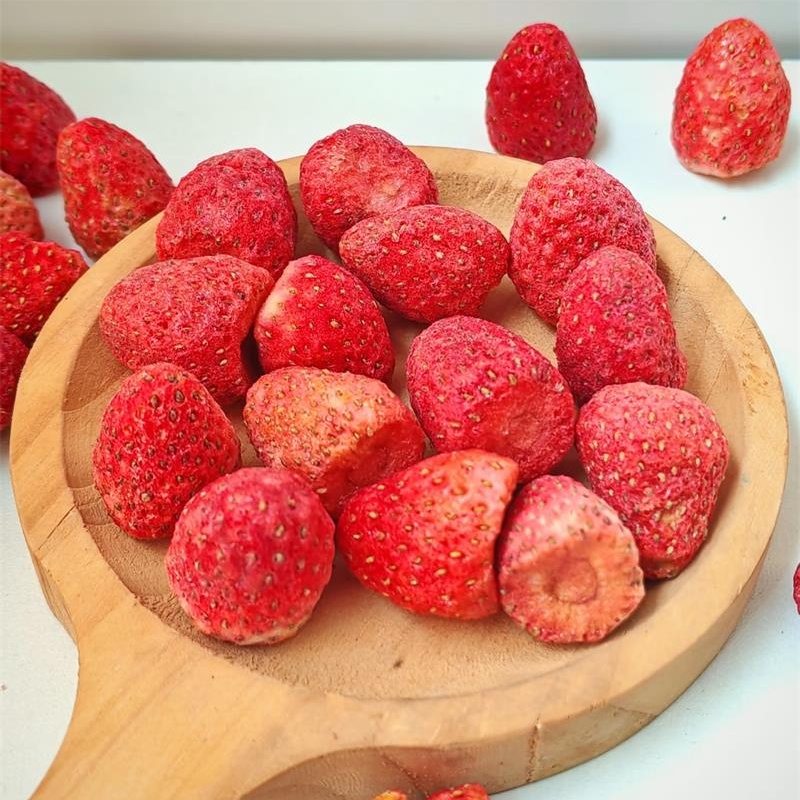
Freeze Drying Is Not Just “Drying Strawberries”
Look, “dried strawberries” can mean a lot of things.
Some are chewy.
Some are dark.
Some are sticky.
Some taste more like sugar than fruit.
Those products may have a place, but they are not the same thing as properly made freeze dried strawberries.
Traditional hot-air drying pushes heat through the fruit to remove water. That heat can change the strawberry in obvious ways. The color darkens. The aroma gets weaker. The structure collapses. The bite becomes chewy instead of crisp.
Freeze drying takes a different route.
The factory starts by selecting fresh strawberries. Then the fruit is frozen fast, usually around minus 35°C to minus 40°C. That fast freezing step matters more than some buyers realize. Slow freezing forms larger ice crystals, and large crystals can damage fruit tissue. Fast freezing helps protect the structure.
Then the frozen fruit moves into a vacuum chamber.
This is the part buyers should understand, even if they are not engineers. Under low pressure, below the triple point of water at 6.11 mbar, the ice inside the strawberry turns directly into vapor. It skips the liquid stage.
No melting.
That is why the fruit does not collapse the same way it might under heavy heat drying.
After primary drying, the factory runs secondary drying to remove the remaining bound moisture trapped inside the fruit matrix. If the process runs well, the finished product can remove up to 98% of the original moisture while keeping much of the fruit’s shape, color, aroma, and crisp structure.
Here is the process in plain factory terms:
| Stage | What Happens | Why Buyers Should Care |
|---|---|---|
| Raw Fruit Sorting | Fresh strawberries are selected and graded | Weak raw fruit becomes weak finished fruit |
| Fast Freezing | Fruit freezes around minus 35°C to minus 40°C | Helps protect shape and fruit tissue |
| Vacuum Sublimation | Ice turns directly into vapor under low pressure | Reduces collapse and stickiness |
| Secondary Drying | Remaining bound moisture is removed | Helps improve shelf stability |
| Final Moisture Check | Product targets less than or equal to 5.0% moisture | Protects crunch, flow, and storage quality |
| Bulk Packing | Product is sealed in moisture-protective packaging | Reduces humidity damage and breakage |
That is the difference.
Good freeze dried strawberries are not simply dried.
They are controlled.
And in bulk sourcing, control is the whole game.
Why Industrial Buyers Should Care About the Process
A retail customer eats a strawberry piece and thinks, “Nice, crunchy.”
A factory buyer thinks differently.
Will it pass through the feeder without breaking?
Will the slices stay visible in granola?
Will the powder clump after three weeks in storage?
Will the fruit pieces hurt chocolate stability?
Will the supplier send the COA before shipment?
Will the next batch look like this batch?
That is the real purchasing conversation.
Bulk freeze dried strawberries move through more abuse than most people imagine. They pass through cutters, dryers, sorters, scales, hoppers, vibratory feeders, conveyors, mixers, cartons, containers, warehouses, and final packing lines.
Every step can damage the product.
So the buyer should choose the strawberry format based on the production use, not just on the nicest product photo.
Whole fruit looks good.
Slices work better in many blends.
Dice give better distribution.
Powder works in formulas, but it needs careful moisture control.
No single form solves every problem.
B2B Application Scenarios
Bulk freeze dried strawberries can fit many industries, but each one asks something different from the ingredient.
That is where inexperienced buyers get caught.
They ask for “freeze dried strawberries” without explaining the end use. The supplier quotes one item. The buyer receives it. Then production complains.
Better approach?
Start with the line. Then choose the cut.
Ready-to-Eat Cereal and Granola
Cereal and granola lines can be rough on fruit pieces.
The strawberry may pass through vibratory feeders, gravity drop packers, blending drums, and carton filling systems. Thin slices can break. Whole berries can crack. Powder can build up at the bottom of bags and make the product look cheap.
For cereal, buyers usually need freeze dried sliced strawberries or carefully selected whole pieces. Thick slices often survive better than thin, fragile ones.
A cereal buyer should check:
Slice thickness
Broken rate
Dust percentage
Moisture level
Bulk density
Color consistency
Feeding performance
Carton strength
Inner bag protection
Here is the honest version: if the product looks great in a small hand-packed sample but falls apart in a feeder, it is not ready for industrial cereal use.
Pretty pieces do not matter if the line turns them into dust.
Premium Dairy, Yogurt, and Dessert Toppings
Yogurt toppings need a different kind of performance.
The fruit should arrive dry and crisp. But once the consumer stirs it into yogurt, the pieces should soften in a pleasant way. Nobody wants a dry center that feels chalky. Nobody wants a soggy piece that disappears instantly either.
This is where sliced and diced strawberries often work better than whole fruit. They rehydrate faster and distribute more evenly in small topping cups.
Do not test this only by eating the fruit dry.
Use the actual yogurt.
Use the actual ratio.
Let it sit for the expected time.
Then taste it.
That small test can prevent a very expensive launch mistake.
Chocolate, Coatings, and Confectionery
Chocolate is strict.
A little moisture can cause a lot of trouble. If strawberry inclusions carry too much moisture, they can affect texture, coating stability, fat bloom, sugar recrystallization, and shelf life.
For chocolate bars, coated snacks, and confectionery blends, buyers should tighten the spec.
Focus on:
Moisture content
Water activity
Particle size
Storage humidity
Packaging barrier
Time exposed after opening
Handling during production
A strawberry inclusion can look beautiful and still be wrong for chocolate.
We have seen this before. The sample tastes good. Everyone likes the color. Then the production team starts asking why the coating behaves strangely.
By then, the cheap ingredient is not cheap anymore.
Pet Food and Functional Treats
Pet food is becoming a serious market for freeze dried fruit.
Brands use fruits in freeze dried pet meals, functional treats, meal toppers, and clean-label pet snacks. Strawberry can add natural color, fiber, and a familiar ingredient story that pet owners understand quickly.
But pet food still needs discipline.
Buyers should check microbial limits, pesticide residues, foreign material control, traceability, and safety documents. A fruit ingredient that looks fine in a photo may still fail a pet food customer’s quality review.
The question is not only:
Can you supply strawberry?
The better question is:
Can you supply clean, traceable, documented fruit ingredients again and again?
That is the standard serious buyers should use.
Nutraceuticals, Beverage Powders, and R&D Labs
Powdered strawberry behaves differently from whole or sliced fruit.
Beverage brands, supplement companies, and R&D labs use powdered strawberry for natural flavor, color, and fruit identity. It can go into protein blends, smoothie powders, instant drinks, wellness formulas, meal replacements, dry dairy blends, and functional foods.
But powder can be annoying.
It may clump.
It may settle.
It may flow badly.
It may look great in water and dull in milk.
It may taste strong alone and disappear in a protein base.
So do not approve powdered strawberry from smell alone.
Mix it in the real formula. Run it through your process. Store it for a few weeks. Shake the pouch. Open it again. Check whether the powder still behaves.
That is how buyers find the truth.
The Problems Buyers Usually Notice Too Late
Product pages love to talk about bright color and nutrition.
Fine.
But procurement teams lose money on different things.
Moisture Creep
Moisture creep is a quiet problem.
The fruit can leave the dryer crisp. It can pass the first inspection. Then moisture starts creeping back in during cooling, packing, storage, container shipping, warehouse handling, or after opening.
The result?
Slices soften.
Whole berries lose crunch.
Powder clumps.
Color starts fading.
Aroma drops.
For bulk freeze dried strawberries, buyers should set moisture at less than or equal to 5.0%. Do not rely on a supplier saying “very dry.” That is not a technical answer.
Ask for the method.
Loss-on-drying works for many cases. Karl Fischer titration gives more precision when the project needs tighter control.
If the supplier cannot explain how they test moisture, slow down.
That is a warning sign.
Broken Pieces and Dust
Freeze dried fruit is light and porous. That gives it the crisp bite.
It also makes it fragile.
Bad packing can destroy good fruit. Weak cartons, loose inner bags, rough pallet loading, and long container transport can all turn clean slices into fragments.
Dust creates several problems.
It hurts retail appearance. It changes yield. It affects dosing. It can clog equipment. It may create quality disputes if the buyer expected clean cuts.
If your line expects clean strawberry slices and receives a carton with heavy dust accumulation, the real cost is not just the price per kilogram.
The real cost includes waste, rework, complaints, and lost line efficiency.
Ask the supplier about:
Broken rate tolerance
Fines percentage
Carton crush strength
Inner liner design
Packing density
Pallet pattern
Inspection after packing
It is not glamorous.
It is necessary.
Residue and Contamination Risk
Fruit ingredients come from agriculture. Agriculture always brings risk.
Pesticide residues.
Foreign matter.
Microbial load.
Allergen contact.
Metal fragments.
Glass.
Plastic.
Stones.
Nobody wants to think about these things when looking at bright red strawberries, but serious buyers have to.
A rejected shipment can delay a launch. A recall can damage a brand. A failed retailer audit can kill a program before it starts.
Bulk buyers should look for an auditable quality system with controls around raw material sourcing, pesticide testing, microbiology, metal detection, X-ray inspection, foreign material control, allergen handling, batch traceability, and certification records.
A lower price does not fix a failed safety review.
Procurement Engineering: Put the Right Details in the Contract
Vague buying language creates vague results.
Do not write “premium freeze dried strawberry, good quality.”
That sounds nice.
It means almost nothing.
A better purchase spec should define format, cut size, moisture, microbiology, packaging, test method, shelf life, and documents.
Sourcing Technical Checklist
| Area | What to Confirm | Practical Target |
|---|---|---|
| Product Format | Whole, sliced, diced, or powdered strawberry | Match the final application |
| Whole Berry Size | Size bracket | 15–25mm or 25–35mm |
| Slice Thickness | Thickness range | 4mm to 6mm |
| Moisture Content | Maximum moisture level | Less than or equal to 5.0% |
| Moisture Test | Verification method | Loss-on-drying or Karl Fischer titration |
| Microbiology | TPC, yeast, mold, coliforms, pathogens | Clear incoming limits |
| Packaging | Inner and outer protection | Aluminum foil liner, desiccant, strong carton |
| Batch Control | COA and traceability | Required for each shipment |
This table may look basic.
That is the point.
A basic shared spec keeps purchasing, QC, production, and the supplier aligned. It stops people from arguing later about what “good quality” was supposed to mean.
Cut Dimensions and Granulometry
Whole berries need size brackets, such as 15–25mm or 25–35mm. That helps with visual consistency, retail fill, and carton planning.
Slices need thickness control. A 4mm to 6mm range gives many buyers a practical starting point. Too thin, and breakage rises. Too thick, and rehydration or blending may change.
Diced fruit should define cut size and tolerance.
Powdered strawberry should include mesh size or particle distribution. Beverage and supplement buyers should take this seriously because powder behavior can change completely when particle size changes.
A “powder” is not just a powder.
Ask anyone who has dealt with clumping in a beverage blend.
Moisture Verification
Moisture needs a number.
For industrial bulk orders, less than or equal to 5.0% is a common maximum target. Buyers can verify it through loss-on-drying, vacuum oven testing, or Karl Fischer titration.
Karl Fischer testing is especially useful for chocolate, powder, nutraceutical, and long-shelf-life products where small moisture differences matter.
Do not accept touch, sound, or appearance as proof of dryness.
A crisp bite is nice.
A test result is better.
Microbiological and Chemical Limits
Bulk buyers should define incoming quality limits before shipment, not after a problem appears.
| Test Item | Suggested Limit |
|---|---|
| Total Plate Count | Less than 10,000 CFU per gram |
| Yeast and Mold | Less than 500 CFU per gram |
| Coliforms | Negative |
| Pathogens | Negative per 25 grams |
Depending on the market and final product, buyers may also need pesticide residue testing, heavy metal testing, sulfite residue checks, allergen statements, GMO statements, metal detection records, X-ray inspection records, and foreign material reports.
Is that a lot?
Yes.
Is it normal for serious food projects?
Also yes.
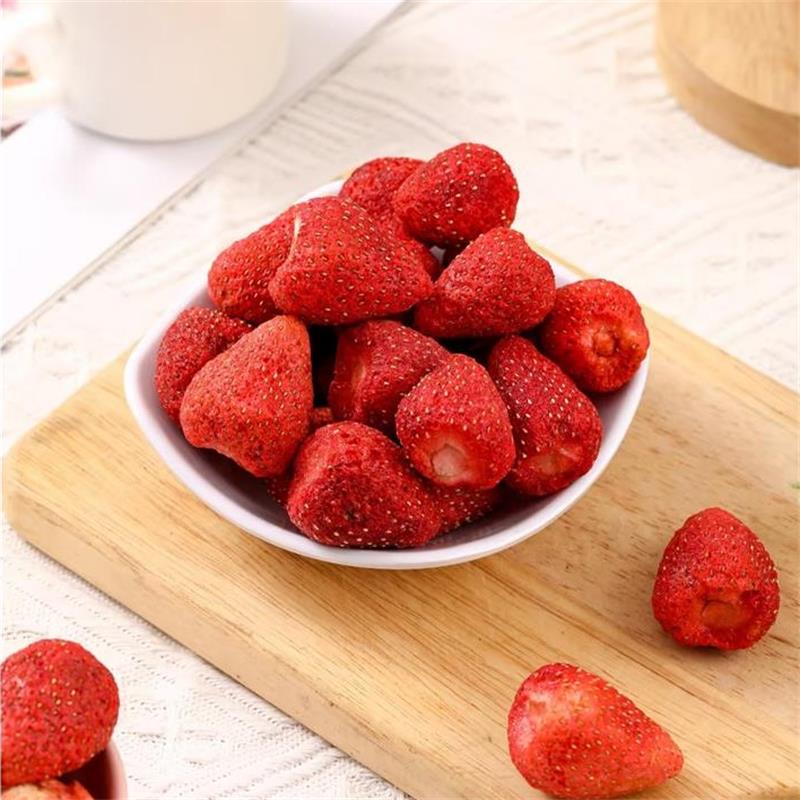
Packaging: The Part That Saves or Ruins the Product
Freeze dried strawberries pull moisture from the air quickly.
That is just the nature of the product.
Once the fruit leaves the dryer, packaging becomes part of the quality system. A weak liner can destroy a well-dried batch. A thin carton can turn whole berries into broken pieces. Poor sealing can turn crisp slices soft before the buyer even opens the shipment.
For bulk export, buyers should look for heavy-duty multi-layer aluminum foil pouches, heat sealing, food-grade desiccants, and strong outer cartons.
Standard thin plastic liners may not be enough for long-distance shipping, especially through humid routes.
The outer carton should use high-crush-test double-wall corrugated cardboard. Pallet design also matters. If cartons shift, compress, or move too much, the buyer may receive fragments instead of clean cuts.
For retail and private-label packs, check:
Moisture barrier
Oxygen barrier
Seal width
Zipper quality
Pouch thickness
Desiccant placement
Shelf-life testing
Carton packing method
Packaging is not decoration.
For freeze dried strawberries, packaging protects the whole commercial value.
Technical Parameters and Compliance Standards
Large buyers need numbers they can compare.
The table below gives a practical baseline for premium bulk freeze dried strawberries.
| Parameter Matrix | Target Industrial Specification | Verification Protocol or Methodology |
|---|---|---|
| Moisture Content | Less than or equal to 5.0% maximum | Karl Fischer Titration or Vacuum Oven |
| Water Activity | 0.15 to 0.30 | Chilled Mirror Dew Point Method |
| Ingredients | 100% Pure Strawberry | HPLC or Chemical Analysis |
| Foreign Material | 0%, free from metal, glass, plastic, and stone | X-Ray Detection and In-line Magnets |
| Sulfite Residues | Free at less than 10 ppm | Optimized Monier-Williams Method |
| Color Profile | Consistent vivid crimson or natural dark pink | Minolta Colorimeter or Visual Match |
| Shelf Life | 18 months | Real-time and Accelerated Stability Testing |
| Storage Temperature | Ambient dry conditions | Facility Environmental Loggers |
Not every buyer needs every test.
A small bakery may not ask for the same documentation as a multinational cereal company. But once the order becomes large, the buyer should stop relying on nice words and start using measurable standards.
Numbers reduce arguments.
That alone makes them worth using.
Sourcing Pitfalls: Where Buyers Get Burned
A supplier’s website can look polished.
A sample can look good.
Neither proves the supplier can support bulk production.
Choosing a Trader When the Project Needs Factory Control
Trading companies can be useful. No need to pretend otherwise.
But technical freeze dried ingredients often require factory-level answers. If you need custom dicing, special powder mesh, lower dust, private-label packaging, audit documents, or monthly repeat shipments, direct factory access becomes more valuable.
A trader may quote fast. But when something goes wrong, they often need to ask the factory behind them. That slows down root-cause correction.
If the project is small, maybe that is fine.
If the project needs consistency, customization, and documents, work with an asset-owning manufacturer when possible.
Ignoring Certification History
Some buyers ask, “Do you have certificates?”
That is not enough.
Ask better questions:
Are the certificates current?
Do they cover the actual production site?
Do they apply to this product category?
Can you send copies before order confirmation?
Have you passed customer audits before?
Can you support BRCGS, IFS Food, HACCP, ISO 22000, Kosher, and Halal requirements when needed?
Missing paperwork can stop a shipment. It can delay customs. It can block retailer approval.
Certificates are not just badges.
They are part of supply risk control.
Forgetting About Production Capacity
A small factory can make a good trial batch.
That does not mean it can supply multi-container monthly orders.
If your brand plans to grow, check the supplier’s drying tunnels, facility size, annual output, raw material plan, peak season strategy, and production schedule.
Capacity affects lead time. It affects price stability. It affects batch consistency.
A supplier that cannot scale with you becomes a bottleneck.
And bottlenecks are expensive.
Working With GrandSong
GrandSong positions itself as a direct manufacturing partner for global buyers that need bulk freeze dried strawberries and related freeze dried fruit ingredients.
Xiamen GrandSong Import & Export Co., Ltd. was established in 2006 in Zhangzhou, Fujian Province. The company operates an 80,000-square-meter processing and lyophilization complex with 29 advanced in-line vacuum freeze-drying tunnels.
That scale is useful for buyers who care about repeat orders, not just samples.
GrandSong also presents a 10,000-ton annual output across multiple functional lines and a team of more than 50 in-house bioengineering and food science R&D specialists.
Here is the core supply infrastructure:
| GrandSong Global B2B Supply Chain Infrastructure |
|---|
| 80,000 m² modern processing and lyophilization complex |
| 29 advanced in-line vacuum freeze-drying tunnels |
| 10,000-ton annual output across multiple functional lines |
| 50+ in-house bioengineering and food science R&D specialists |
| Global certifications including BRCGS, HACCP, KOSHER, and HALAL |
For buyers, those numbers answer a simple question:
Can this supplier repeat the work after the first sample?
GrandSong ships freeze dried strawberries bulk ingredients to customers across the United States, Europe, the Middle East, and Southeast Asia. The company supports breakfast cereal ingredients, beverage powders, pet food formulations, snack products, and private-label retail packaging.
Different buyers need different support.
A cereal line may need thick freeze dried sliced strawberries.
A beverage brand may need fine powdered strawberry.
A pet food company may care most about traceability and safety documents.
A private-label snack brand may need retail pouches, carton marks, and export paperwork.
A distributor may need 5kg or 10kg bulk cartons with steady repeat supply.
That is why production scale matters.
Not because bigger always means better.
Because bulk orders require equipment, people, documents, scheduling, and quality discipline working together.
GrandSong can support customized dicing, fine powder formats, technical samples, factory audits, and custom MOQ discussions for international projects.
FAQ
What is the Minimum Order Quantity for bulk industrial shipments?
The standard factory MOQ requires a 20GP container load to optimize shipping efficiency and maintain competitive pricing. For initial formulation trials and brand validation, GrandSong can mix 3 to 4 different stock keeping units inside a single trial container.
How does the factory prevent fruit cuts from crumbling into dust during transit?
GrandSong controls product degradation through both processing and packaging design. The factory adjusts cutting systems to reduce weak points in the fruit tissue, then packs bulk products inside high-strength corrugated boxes lined with thick, sealed aluminum foil bags. This structure helps reduce shifting and physical impact during international transport.
What are the standard lead times for custom OEM or ODM contract manufacturing?
Standard ready-to-ship inventory typically clears the facility within 15 days. For custom private-label processing, specialized cuts, or bespoke retail packaging, production usually takes 25 to 30 days, depending on order volume and technical requirements.
What payment terms apply to international contract orders?
GrandSong works under standard international B2B payment terms: 30% T/T deposit to secure production lines and material sourcing, with the remaining 70% T/T balance due upon presentation of the corresponding Bill of Lading.
Can buyers request technical samples before placing a bulk order?
Yes. Buyers should request technical samples before confirming bulk production. Samples help food brands test cut size, color, texture, moisture behavior, powder flow, rehydration, and compatibility with the final application.
Conclusion
Bulk freeze dried strawberries are not a simple commodity once the buyer needs industrial performance.
They are a technical fruit ingredient.
Moisture decides whether the product stays crisp. Cut size decides whether it runs well on the line. Packaging decides whether the fruit arrives clean or broken. Microbiology decides food safety. Certifications decide market access. Factory capacity decides whether the supplier can repeat the order month after month.
That is why the cheapest quotation rarely tells the whole story.
A serious buyer should define the application first. Then specify the format, moisture limit, microbiological requirements, packaging design, certification needs, and delivery plan. After that, test samples in the real product before approving bulk production.
GrandSong gives buyers access to large-scale freeze-drying capacity, certified food safety systems, R&D support, and export experience for global food brands, pet food innovators, snack processors, and private-label developers.
A good sample can start the conversation.
Stable supply keeps the business.
