

Introduction
Fresh strawberries are wonderful when you eat them straight away.
In commercial food production, they can be a headache.
They bruise. They spoil. They leak juice. They need cold storage. Their taste changes with season. Their moisture can soften cereal, disturb chocolate, change bakery texture, and make powders difficult to manage.
So food brands look for another way to keep strawberry character without dragging fresh-fruit problems into the formula.
That is where Freeze Dried Strawberry fits.
It removes most of the water from fresh strawberry while keeping much of the fruit’s shape, color, aroma, and taste. The result is light, crisp, and easy to use in many food applications.
You see it in snack pouches, breakfast cereal, granola, yogurt toppings, bakery mixes, dessert products, smoothie powders, ice cream toppings, chocolate, trail mixes, foodservice packs, and freeze dried meals.
Good product developers like that flexibility.
Procurement teams like it too, but only when the supplier can control quality. A pretty sample is not enough. Bulk buyers need low moisture, clean flavor, stable color, proper packaging, correct documents, and repeatable batches.
That last part matters.
A brand can sell the first batch with excitement. If the second batch arrives darker, softer, dustier, or different in size, the brand has a problem.
So this guide looks at Freeze Dried Strawberry from a buyer’s point of view. What is it? Which format should you choose? What makes it useful? Where does it fail? What should you ask before ordering freeze dried strawberries bulk?
Let’s keep it practical.
What It Is
Freeze Dried Strawberry starts with fresh strawberries.
The factory freezes the fruit first. Then it removes frozen water under vacuum. The water leaves as vapor instead of melting into liquid. This low-temperature process helps protect the fruit’s structure, color, aroma, and strawberry flavor.
That is why a good freeze dried strawberry feels crisp.
Not sticky.
Not leathery.
Not cooked.
Ordinary dried strawberries often use heat. Some become chewy. Some turn darker. Some taste more like sugar than fruit. Some include added sweeteners. That may fit certain snack products, but it does not suit every clean-label brand or dry formulation.
Freeze dried strawberries behave differently because they contain very little moisture. They work better when a brand needs fruit flavor without adding water to the final product.
GrandSong’s Freeze Dried Strawberry information lists whole, slice, dice, and powder formats. It also lists 100% pure strawberry with no additives. For B2B buyers, those two points are worth slowing down for.
Why?
Because format decides application.
A snack brand may want freeze dried whole strawberries. A cereal company may need freeze dried sliced strawberries. A bakery may prefer powdered strawberry. A foodservice buyer may ask for freeze dried strawberries bulk in cartons.
So no, “Freeze Dried Strawberry” is not one fixed item.
It is a small product family.
Freeze Dried Whole Strawberries
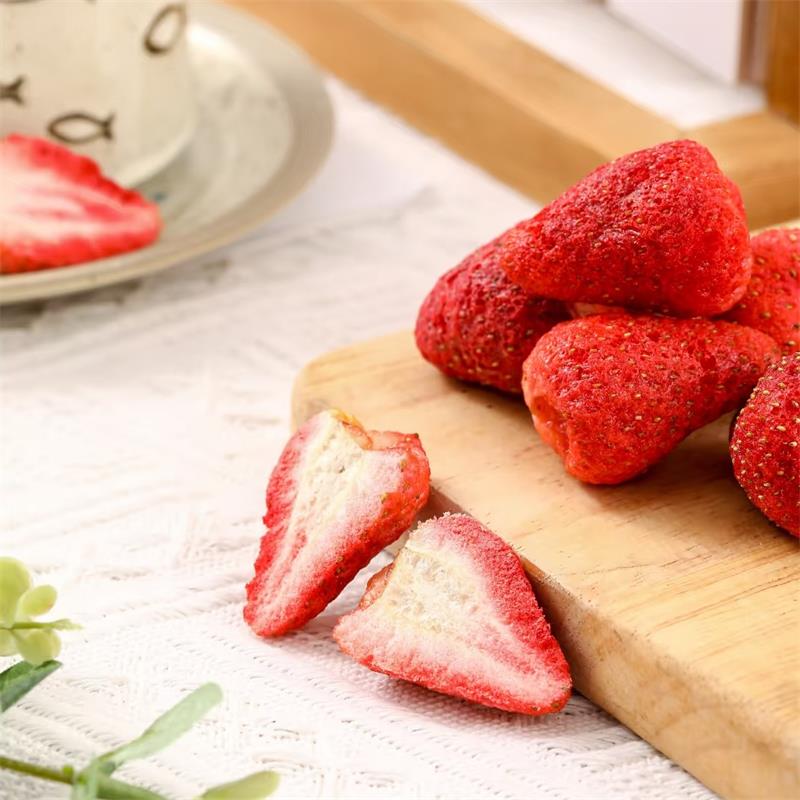
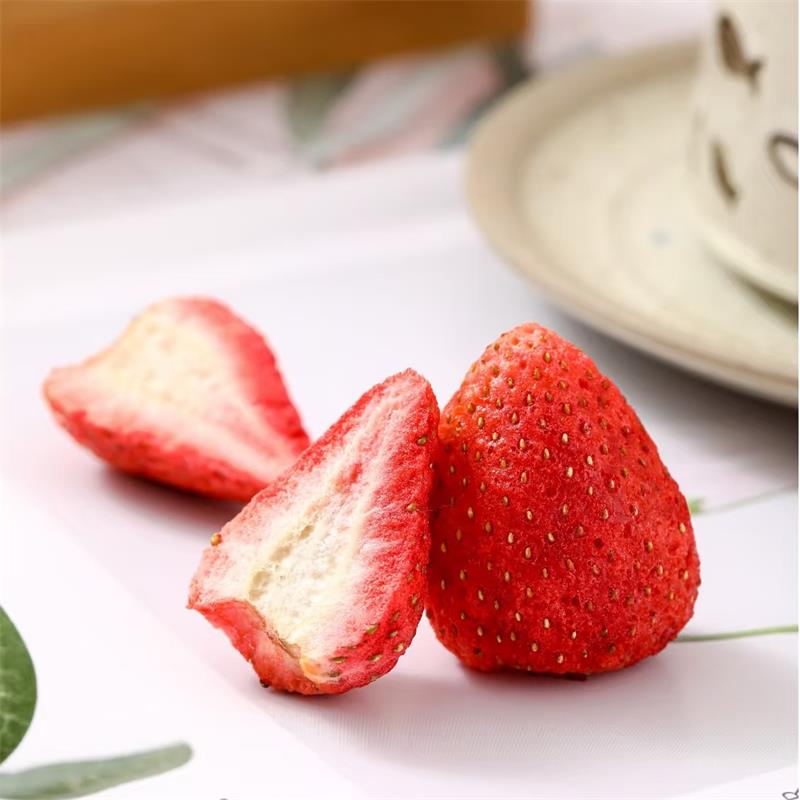
Freeze dried whole strawberries carry the strongest visual value.
The customer sees the full fruit shape and immediately understands the product. No explanation needed. That makes whole strawberries useful for premium snack pouches, gift packs, mixed fruit boxes, children’s snacks, and products where appearance helps sell the item.
Whole fruit feels honest.
But it is also demanding.
The raw material needs careful sorting. Size matters. Shape matters. Ripeness matters. Color matters. A supplier cannot hide uneven fruit after freeze drying. Whatever goes into the process comes out with its strengths and weaknesses exposed.
There is also breakage.
Whole freeze dried strawberries can crack during packing or shipping if the supplier uses weak cartons or leaves too much room inside the bag. A small sample may arrive beautifully. A bulk order may not.
So if you plan to buy freeze dried whole strawberries, ask about raw material grade, size range, broken rate, packing method, and moisture control.
That is where the real buying decision starts.
Freeze Dried Sliced Strawberries
Freeze dried sliced strawberries are often the most useful form for food brands.
They show clear strawberry identity, but they also blend more easily than whole fruit. You can use them in cereal, granola, oatmeal, yogurt toppings, bakery decoration, trail mix, chocolate, and snack mixes.
Slices give color without taking over the whole product.
A cereal brand, for example, usually does not need large whole strawberries. It needs red fruit pieces that spread nicely through the mix and still look attractive after packing. Slices do that job well.
But slices are fragile.
Thin pieces can break into flakes. Too much dust can make the final product look cheap. If the buyer needs neat slices, the supplier must control cut thickness, drying condition, inner packaging, carton strength, and shipping handling.
A buyer should test this before ordering a full container.
No guessing.
Diced Freeze Dried Strawberries
Diced strawberries are not always the most beautiful form in photos.
Factories still love them.
They blend evenly. They portion well. They help keep every serving more consistent. That matters in oatmeal cups, cereal blends, nutrition bars, bakery fillings, dessert mixes, dry toppings, and industrial food production.
If the buyer wants fruit distribution instead of big visible fruit pieces, diced strawberry often makes better sense.
It is a working ingredient.
Not a showpiece.
And that is exactly why many manufacturers choose it.
Powdered Strawberry
Powdered strawberry has a different job.
It does not provide visible fruit pieces. It provides strawberry flavor, color, and fruit identity inside a formula.
Bakeries use powdered strawberry in frosting, fillings, cake mixes, cookies, cream systems, macarons, glazes, and dessert blends. Beverage brands use it in smoothie powders, milkshake powders, fruit tea blends, protein drinks, and instant mixes. Confectionery brands may use it in coatings, chocolate, and flavor systems.
The advantage is clear: powdered strawberry adds fruit character without adding fresh fruit water.
That helps product developers a lot.
But powder needs respect.
It absorbs moisture quickly. It can clump. It can lose flow. It can darken if storage is poor. It may behave one way in water and another way in milk, cream, protein powder, or fat-based filling.
So do not approve powdered strawberry only by smelling it from a sample bag.
Mix it.
Bake it.
Blend it.
Test it in the real product.
Why It Wins
Freeze Dried Strawberry works because it sits between consumer appeal and technical function.
It looks like real fruit.
It tastes like strawberry.
It stays light.
It keeps moisture low.
It fits many product formats.
That is a useful combination.
It Keeps Strawberry Character
Strawberry is easy to sell because customers already know it.
A red strawberry slice in cereal makes the product look more generous. Whole fruit in a pouch creates a clean, simple snack story. Powdered strawberry in frosting can make a bakery product feel more natural than a flat artificial flavor.
This is why Freeze Dried Strawberry fits clean-label snacks, breakfast products, toppings, bakery, desserts, and children’s food.
It does not need much explanation.
The fruit does the talking.
It Gives Crunch
Crunch matters.
A lot.
If a consumer buys freeze dried fruit and finds soft pieces, the product feels old. It may still be safe, but the eating experience drops immediately. In retail snacks, that can kill repeat purchase.
Crunch depends on low moisture and good packaging.
That means buyers should care about moisture specifications, pouch barrier, sealing quality, storage advice, and desiccant use when needed.
These details may sound boring in a sales email.
They are not boring when a customer leaves a bad review.
It Carries Strong Flavor
When water leaves the strawberry, the flavor becomes more concentrated.
That is why powdered strawberry can work well in frosting, fillings, coatings, beverages, and dry mixes. It is also why slices and diced pieces can bring quick fruit flavor when eaten dry or mixed into food.
For brands that need strawberry taste without fresh fruit water, Freeze Dried Strawberry gives more control.
Less water.
More fruit signal.
That is useful in product development.
It Supports Shelf Stability
GrandSong lists 5% max moisture and 18 months of shelf life under proper storage for its Freeze Dried Strawberry.
For importers, distributors, foodservice buyers, and private-label brands, this matters. They need enough time to ship, warehouse, sell, and reorder without constant spoilage pressure.
Still, shelf life depends on handling.
Keep the product dry. Keep it sealed. Keep it away from heat, sunlight, and humidity. After opening, close the package quickly.
Simple advice.
Easy to ignore.
Costly when ignored.
Technical Advantages
Freeze drying gives this product more than a nice texture. It changes how the strawberry behaves in commercial food systems.
GrandSong lists FD processing, 100% pure strawberry, no additives, 5% max moisture, 18-month shelf life, room-temperature storage, 20g to 100g retail weights, customized packaging, and 5kg or 10kg bulk cartons.
Those details help buyers compare suppliers in a practical way.
Moisture Control
Moisture control is the heart of Freeze Dried Food quality.
If moisture stays low, the fruit stays crisp. Powder flows better. Slices hold texture. Shelf life becomes more predictable.
If moisture rises, problems show up quickly.
Whole pieces soften. Slices lose crunch. Powder clumps. Color may dull. The finished product may no longer match the brand promise.
For freeze dried strawberries bulk, buyers should ask for the moisture standard, COA support, packing details, and storage guidance.
A serious supplier should answer clearly.
If they cannot, be careful.
Texture Retention
Freeze drying helps the fruit hold its structure better than many heat-based methods.
That is why freeze dried whole strawberries can still look like strawberries. It is also why freeze dried sliced strawberries can work in cereal, granola, toppings, and bakery decoration.
Texture retention creates product design options.
Snack brands can sell crisp fruit. Cereal brands can show visible slices. Bakeries can decorate desserts. Foodservice buyers can offer fruit toppings without handling fresh berries every day.
But texture retention only helps if the product reaches the buyer in good condition.
Packaging still matters.
Flavor Concentration
Freeze Dried Strawberry often gives a cleaner fruit taste than ordinary dried strawberries because the process avoids heavy heat damage.
Powdered strawberry benefits from this even more. It can bring a strong fruit note to frosting, fillings, coatings, drinks, and dry blends.
A good powder does not just taste sweet. It should taste like strawberry.
That sounds obvious, but buyers know the difference after testing several samples.
Room-Temperature Storage
Freeze Dried Strawberry can be stored at room temperature under proper conditions.
That helps brands avoid cold-chain pressure. Warehousing becomes easier. Distribution becomes easier. Foodservice handling becomes easier.
But room-temperature storage does not mean careless storage.
The product still needs a dry, cool, dark place. Keep it sealed. Keep it away from strong humidity changes.
A good ingredient can fail in a bad warehouse.
Use Scenarios
Freeze Dried Strawberry works in many products because it can act as both a finished snack and an ingredient.
That is why it attracts different kinds of buyers.
Snack Packs
For retail snacks, buyers often choose freeze dried whole strawberries or freeze dried sliced strawberries.
Whole pieces look premium. Slices are easier to eat and may help control cost. Mixed fruit packs use strawberry because the red color stands out quickly.
In snack packs, focus on color, crunch, aroma, broken rate, pouch barrier, and seal strength.
The customer opens the pouch and decides fast.
Crisp?
Good.
Soft?
Problem.
Cereal and Granola
Cereal and granola brands usually prefer freeze dried sliced strawberries or diced pieces.
Slices create visible fruit appeal. Diced pieces distribute more evenly. Both help brands add fruit character without adding fresh moisture to the mix.
Buyers should test breakage during mixing and packing. A small sample bag does not show what happens on a production line.
Run the test.
It saves trouble.
Yogurt Toppings
Yogurt topping cups need attractive fruit pieces and quick flavor release.
Freeze dried sliced strawberries and diced pieces work well. They should look bright and stay crisp before mixing. Once they meet yogurt, they will soften. That may be fine if the product is designed that way.
The buyer should test the eating experience exactly as the consumer will use it.
Powdered strawberry can also work in dairy systems, but color, acidity, sweetness, and blending behavior need testing.
Bakery and Dessert
Bakeries use slices for decoration and powdered strawberry for flavor.
Powder works in frosting, fillings, cream, cookies, cakes, macarons, glazes, and dessert mixes. It adds strawberry flavor without adding much water.
That is a big advantage in bakery.
But bakery rooms can be humid. Workers may open bags and leave them open. Powder clumps. Slices soften. Then people blame the ingredient.
Sometimes the real problem is handling.
Open smaller portions. Reseal quickly. Store dry.
Old-school advice.
Still works.
Beverage and Smoothie Products
Powdered strawberry fits smoothie powders, milkshake powders, fruit tea blends, protein drinks, and instant beverage mixes.
But beverage buyers need to test carefully.
Does it disperse?
Does it settle?
Does it clump?
Does the color hold in water or milk?
Does the strawberry note survive other ingredients?
A powder may smell strong in dry form and still perform badly in a finished drink.
Do not skip application testing.
Ice Cream and Confectionery
Freeze dried strawberries can work in ice cream toppings, chocolate, candy, coatings, and dessert inclusions.
Slices and diced pieces add texture and color. Powder adds flavor and natural fruit character.
High-fat systems and humid processing areas need extra testing. Chocolate and cream products can behave differently from dry snacks.
So again, test the real formula.
Bulk Manufacturing
Freeze dried strawberries bulk suits repacking, bakery use, ingredient blending, foodservice supply, cereal production, and private-label projects.
GrandSong lists 5kg and 10kg bulk carton options.
For bulk buyers, the main points are moisture, carton strength, inner packaging, batch consistency, lead time, and documents.
Bulk orders make small mistakes bigger.
That is why the spec must be clear before production.
Pain Points
Buyers usually compare freeze dried strawberries because they want better performance than ordinary dried fruit.
But this category still has risks.
Short Shelf Life in Fresh Fruit
Fresh strawberries spoil fast.
That creates waste for bakeries, foodservice operators, snack brands, and distributors. Freeze Dried Strawberry helps reduce that pressure by offering longer shelf stability under proper storage.
For buyers working across seasons or long shipping routes, this is a real advantage.
Flavor Loss in Ordinary Dried Fruit
Regular dried strawberries can lose the bright strawberry note during heat drying. Some taste cooked. Some taste mostly sweet. Some look brownish.
Freeze drying can preserve a cleaner fruit flavor when the raw material and process are controlled well.
That difference matters when the product sells on natural taste and color.
Moisture Damage
Moisture damages freeze dried fruit quickly.
Everyone knows this.
Many people still underestimate it.
A weak seal, humid warehouse, open bag, or poor inner liner can turn crisp fruit soft. Powder can clump. Texture can drop. Complaints follow.
Packaging and storage are not afterthoughts.
They are part of the product.
Inconsistent Particle Size
Manufacturers need stable sizing.
If slices change size, the product appearance changes. If diced pieces vary too much, blending becomes uneven. If powder particle size changes, mixing behavior can shift.
Buyers should confirm cut size, powder fineness, and tolerance before repeat orders.
A clear spec sheet saves many emails later.
Poor Rehydration or Formula Behavior
Some products need the fruit to rehydrate. Some need it to stay crisp. Some need powder to disperse well. Some need visible pieces that survive mixing.
No supplier photo can answer all of that.
Only application testing can.
Supply Consistency
The first sample gets attention.
Repeat quality keeps the account.
That is the part many buyers learn the hard way.
A supplier may send a beautiful sample, then struggle with the second or third order. Color changes. Slice size changes. Moisture changes. Broken rate rises. Documents arrive late.
For brands, that creates real trouble.
A reliable freeze dried food manufacturer needs control over raw material sourcing, freeze-drying conditions, sorting, moisture testing, packaging, storage, and export documentation.
Bulk supply is not only production volume.
It is the ability to repeat the same standard.
Shelf Stability
Shelf stability depends on drying, packaging, storage, and handling.
Retail packs should protect against humidity and oxygen. Bulk cartons need strong inner bags and outer cartons. Opened bags should be sealed quickly. Warehouses should stay cool and dry.
GrandSong lists 18 months of shelf life under proper storage.
That gives buyers a useful planning window, but only when the product is protected after delivery.
Do not let a good product sit in a hot, damp corner of the warehouse.
It will not thank you.
Selection Criteria
A simple buying order works best.
First, define the application.
Then choose the format.
Then confirm parameters.
Then check the supplier.
GrandSong offers whole, slice, dice, and powder formats, so buyers can match the product to snack, bakery, beverage, cereal, foodservice, or industrial uses.
Whole Fruit
Choose freeze dried whole strawberries when the final product needs strong visual impact.
Best for premium snack pouches, gift packs, mixed fruit packs, and retail products where full fruit shape helps sell the product.
Whole fruit needs better sorting and stronger protection during packing.
Sliced Fruit
Choose freeze dried sliced strawberries when you need visible fruit pieces with better portion control.
Best for cereal, granola, oatmeal, yogurt toppings, bakery decoration, chocolate, and trail mix.
Slices give a good balance of appearance, cost, and usability.
Diced Fruit
Choose diced pieces when even distribution matters.
Best for nutrition bars, oatmeal cups, dessert mixes, bakery fillings, cereal blends, and industrial dry mixes.
Diced fruit may look less premium than whole fruit, but it often works better in production.
Powder Form
Choose powdered strawberry when the formula needs strawberry flavor and color rather than visible fruit pieces.
Best for frosting, fillings, beverage premixes, dry mixes, smoothies, protein blends, dairy products, and color-flavor systems.
Powder needs good moisture protection and real formula testing.
Parameter Advice
For procurement teams, a parameter sheet is more useful than a pretty description.
GrandSong lists 100% pure strawberry, FD process, 20g to 100g retail weights, customized packaging, 5kg or 10kg bulk cartons, 5% max moisture, and 18-month shelf life under proper storage.
Use those points as a base when comparing suppliers.
Suggested specs by use
| Use Case | Suggested Direction |
|---|---|
| Snack retail | Whole or sliced pieces, resealable foil pouch, low moisture, visible fruit shape |
| Bakery and dessert | Sliced pieces or powder, controlled particle size, reliable flavor release |
| Industrial bulk use | Stable bulk box packing, documented shelf life, moisture limit, customized cut size |
| Beverage powder | Powdered strawberry, good flowability, clear particle size, moisture protection |
| Cereal and granola | Sliced or diced pieces, low dust, controlled broken rate, strong color |
Core parameters to confirm
| Parameter | Why It Matters |
|---|---|
| Ingredient declaration | Confirms whether the product is 100% strawberry or customized |
| Product form | Whole, slice, dice, and powder serve different applications |
| Moisture spec | Helps protect crispness, flowability, and shelf life |
| Shelf life | Supports retail planning and distribution |
| Packaging | Protects against humidity, oxygen, breakage, and handling damage |
| MOQ and lead time | Affects launch planning and repeat orders |
| Certificates | Supports importer, distributor, and retailer approval |
| Batch consistency | Helps brands maintain stable finished products |
Common Mistakes
Most problems start small.
Then the shipment arrives.
That is when small details get expensive.
Choosing the Wrong Format
A buyer loves the look of freeze dried whole strawberries.
Then they try to use them in cereal.
Too large. Too irregular. Too costly.
Another buyer chooses powdered strawberry because it seems efficient, then realizes the finished snack needs visible fruit pieces.
The format should follow the product.
Not the photo.
Ignoring Storage Conditions
Freeze dried food hates humidity.
Plain truth.
If the product absorbs moisture, slices soften, whole pieces lose crunch, and powder clumps. Buyers should store the product in a cool, dry, dark place and reseal opened bags quickly.
This needs warehouse training.
Not just a line in the specification sheet.
Buying Only on Price
A low price can look tempting.
But the cheapest option may bring weak flavor, dull color, high dust, poor packaging, unstable moisture, slow delivery, or weak documents.
For B2B buyers, the real cost includes waste, complaints, failed trials, delayed launches, and lost repeat orders.
Price matters.
It just should not make the whole decision.
Skipping Sample Testing
Never approve a product only by photos.
Test the sample in the real application. Put slices into cereal. Mix powder into frosting. Blend powder into drinks. Pack whole strawberries into the actual pouch. Check breakage after handling.
A product can taste fine alone and still fail in the final SKU.
Forgetting Packaging Details
Packaging protects the value of Freeze Dried Strawberry.
Retail buyers should check pouch barrier, zipper, seal strength, and shelf-life performance. Bulk buyers should check inner bags, carton strength, pallet loading, and moisture protection.
Weak packaging can ruin good fruit before the customer ever sees it.
Buyer Checklist
Before placing an order, check these points:
Ingredient declaration: 100% strawberry or customized formula
Product form: whole, slice, dice, or powder
Moisture spec: confirm max moisture and storage guidance
Packaging: retail pouch or bulk carton based on channel
Shelf life: confirm expected shelf life under proper storage
Supply capacity: verify stock, MOQ, and delivery window
Certificates: confirm HACCP, BRC, HALAL, KOSHER, organic, or other required documents
Samples: test in the final application before bulk approval
Batch control: ask how the supplier keeps quality consistent
Export support: confirm documents, carton marks, and shipping details
This checklist keeps the supplier conversation grounded.
No vague promises.
No “trust us.”
Just the details that affect the order.
Why GrandSong
GrandSong presents Freeze Dried Strawberry as a product for retail and bulk supply. The product page lists whole, slice, dice, and powder formats, 100% pure strawberry, no additives, 5% max moisture, and 18-month shelf life under proper storage.
It also lists 20g to 100g retail packaging, customized packaging, and 5kg or 10kg bulk carton options.
That range matters because buyers do not all need the same packing.
A retail snack brand may need small pouches. A bakery may need powder in larger bags. A distributor may want 10kg cartons. A private-label buyer may need customized packaging and export documents.
GrandSong also lists HACCP, BRC, HALAL, KOSHER, and organic certification. The company presents advanced freeze-drying production lines, annual output of 10,000 tons, and export experience across multiple regions.
For B2B buyers, these points help answer the real question:
Can this supplier support repeat business?
A sample can impress.
Stable supply can keep the account.
FAQ
1. What is Freeze Dried Strawberry?
Freeze Dried Strawberry is real strawberry fruit processed through freeze drying. The process removes moisture while helping the fruit keep much of its shape, color, flavor, and original character.
2. Are dried strawberries the same as freeze dried strawberries?
No. Dried strawberries often use heat-based dehydration. Freeze dried strawberries use freezing and vacuum drying, which usually creates a lighter texture, brighter color, and crispier bite.
3. What is the best format for baking?
Freeze dried sliced strawberries and powdered strawberry usually work best for baking. Slices work well for decoration and visible inclusions. Powder works well in frosting, fillings, cookies, cakes, and flavor systems.
4. Can freeze dried strawberries be bought in bulk?
Yes. Freeze dried strawberries bulk options usually include larger cartons or bags for commercial buyers. GrandSong lists 5kg and 10kg bulk carton options, along with customized packaging.
5. How should freeze dried food be stored?
Store freeze dried food in a cool, dry, dark place. Keep it sealed and away from humidity, heat, and temperature swings. After opening, reseal the package quickly or move the product to an airtight container.
Conclusion
Freeze Dried Strawberry works because it gives food brands something fresh fruit cannot always provide: strawberry flavor, low moisture, light texture, flexible formats, and easier storage control.
It can become a retail snack, a cereal topping, a bakery ingredient, a beverage powder component, a dessert inclusion, or a bulk ingredient for manufacturers.
Whole fruit, slices, dice, and powder each have their place. The right choice depends on the final product.
For B2B buyers and private-label brands, the buying logic should stay practical. Confirm the ingredient statement. Match the form to the application. Check moisture. Review packaging. Test samples in the real product. Ask for documents. Make sure the supplier can repeat the same quality after the first order.
That is what separates a nice sample from a dependable ingredient.
And in bulk food sourcing, dependable wins.
