

What Is Freeze Dried Strawberry?
Freeze Dried Strawberry means strawberry processed through FD technology, also called freeze drying or lyophilization. The factory freezes fresh strawberries first. Then the vacuum system removes ice from the fruit by turning frozen water into vapor. The process helps the fruit keep much of its shape, color, aroma, and taste.
That is the simple explanation.
The business meaning goes deeper.
The freeze-drying process gives buyers a strawberry ingredient that feels crisp, stores well under proper conditions, weighs less than fresh fruit, and works in many dry food systems. That makes it useful for snacks, cereal, granola, yogurt toppings, bakery, confectionery, beverage powder, trail mix, and freeze dried meals.
We like this product because it gives food brands flexibility.
One fruit. Several forms. Many channels.
A buyer can use freeze dried whole strawberries for a premium snack pouch. Another buyer can use freeze dried sliced strawberries for cereal. A bakery can grind or buy powdered strawberry for frosting, fillings, cookies, cakes, and chocolate coatings. A distributor can order freeze dried strawberries bulk for foodservice or industrial customers.
Same raw fruit family.
Different commercial logic.
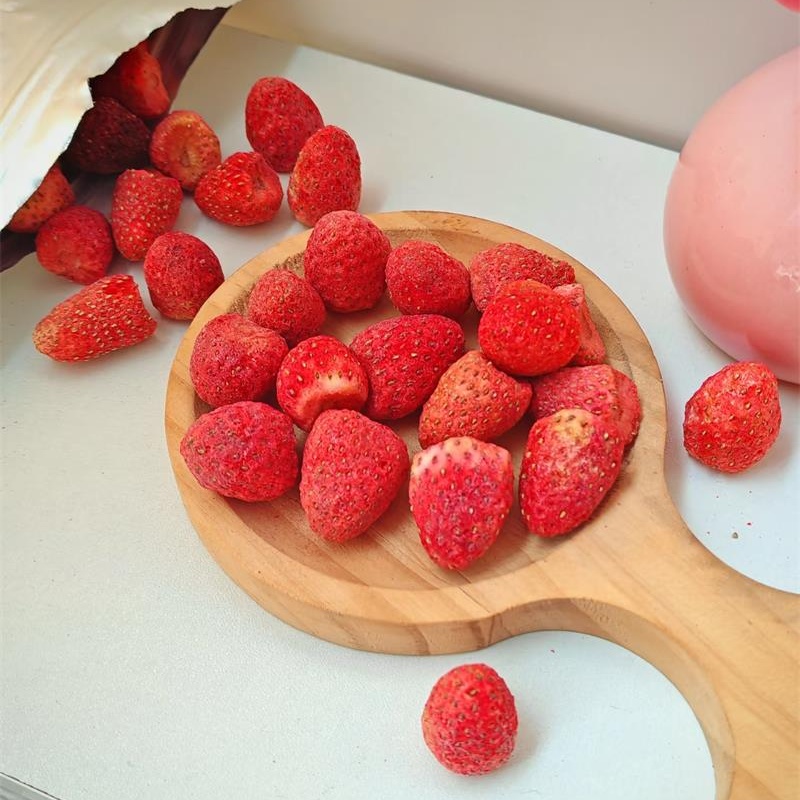
Freeze Dried Whole Strawberries
Freeze dried whole strawberries make the strongest visual impression.
No debate.
They look like real fruit because they are real fruit. Consumers can see the shape. Retail brands can use that look to build a premium snack line, gift pack, healthy children’s snack, or topping product.
Whole strawberries work especially well when the fruit itself acts as the hero of the product. A clear pouch with bright whole strawberries can sell quickly because the value feels obvious. The buyer does not need to explain much.
Still, whole strawberries demand stricter sourcing.
Size consistency matters. Maturity matters. Raw fruit shape matters. Sorting matters. If the original strawberry has uneven color, weak structure, or poor shape, the finished product shows it immediately.
Whole pieces also break more easily during packing and shipping. So we always tell buyers to pay attention to carton strength, inner bag structure, headspace control, and shipping route.
Pretty product. Fragile product.
Treat it that way.
Freeze Dried Sliced Strawberries
Freeze dried sliced strawberries probably fit the widest range of B2B uses.
They look attractive, but they also blend better than whole fruit. That makes them useful in cereal, granola, yogurt toppings, oatmeal cups, bakery decoration, snack mixes, chocolate bars, and retail fruit blends.
Slices give brands a nice balance between appearance and cost.
A cereal brand, for example, may not want whole strawberries. Too large. Too expensive. Too uneven in every spoonful. Slices spread red color across the product and make the final mix look richer.
We have noticed that many first-time buyers choose sliced strawberries after they compare all forms. They still get strong visual value, but they also gain better portion control.
The main risk?
Breakage.
Thin slices can turn into flakes or powder if the supplier dries, packs, or ships them carelessly. Buyers should set a clear broken-rate standard before confirming bulk orders.
Diced Freeze Dried Strawberries
Diced freeze dried strawberries work well when the buyer needs dosing control.
Think cereal blends, instant oatmeal, nutrition bars, bakery fillings, ice cream toppings, children’s snacks, and industrial ingredient mixes. Diced pieces spread evenly. They reduce the “one big piece here, no fruit there” problem.
That matters in factory production.
A food manufacturer wants every bag or serving to look consistent. Diced pieces help with that.
They also reduce some visual breakage concerns because buyers already expect smaller fruit pieces. Still, dust control matters. Too much powder can affect product appearance, flavor distribution, and packaging cleanliness.
For mixed dry foods, diced strawberry often gives the best practical result.
Not the most dramatic.
The most useful.
Powdered Strawberry
Powdered strawberry opens another door.
Instead of giving visible fruit pieces, it gives flavor, color, and fruit identity inside a formula. Beverage powder brands use it. Bakeries use it. Dairy brands use it. Confectionery teams use it. Nutrition powder companies use it. Dessert mix brands use it.
Powdered strawberry works in smoothie powder, milkshake mix, protein blends, frosting, cream fillings, cookies, cakes, chocolate, sauces, yogurt bases, and instant food products.
But powder has a problem.
Moisture.
It absorbs moisture fast. Then it clumps. It loses flow. It may darken. It may stick inside the bag. It may create trouble on a production line.
So powdered strawberry needs stronger packaging discipline than many buyers expect. The supplier should discuss moisture level, particle size, flowability, packaging barrier, storage conditions, and anti-caking needs where the formula allows.
A cheap powder that clumps inside the carton does not save money.
It creates waste.
Sugar and Sugar-Free Options
Buyers should never assume that all dried strawberries use the same ingredient statement.
Some products use 100% pure strawberry. Some dried strawberries include sugar. Some powders may include a carrier or flow aid. Each option changes the label, nutrition panel, taste, cost, and market position.
Clean-label snack brands often prefer 100% fruit. Sweet snack brands may accept sugar-added products. Beverage powder brands may ask for better flow and blending behavior.
No single answer fits every buyer.
We always recommend one simple habit: confirm the formula before you ask for the final quotation.
That small step prevents big trouble later.
Scenario: Where B2B Buyers Use Freeze Dried Strawberry
A smart sourcing plan starts with the use case.
Not the lowest quote.
That may sound blunt, but it saves buyers from mistakes. A strawberry slice for cereal does not need the same structure as a whole strawberry snack. Powdered strawberry for beverages does not need the same standard as strawberry powder for frosting. Diced fruit for oat cups does not follow the same logic as whole fruit for gift packaging.
Application first. Price second.
Healthy Snack Brands
Snack brands love Freeze Dried Strawberry because it feels clean, bright, crunchy, and easy to understand. Consumers recognize the ingredient. They do not need a long explanation.
A good strawberry snack should look fresh, taste natural, and crunch cleanly.
That is the promise.
For this category, buyers usually focus on:
Bright red color
Crunchy texture
Natural strawberry aroma
Low broken rate
Attractive retail packaging
Stable shelf life
Clear ingredient statement
Good sensory consistency
Freeze dried whole strawberries create a premium feel. Freeze dried sliced strawberries give better cost control and easier eating. Diced pieces work well in mixed fruit pouches, children’s snacks, and small serving packs.
Packaging decides a lot here.
A snack brand can buy a beautiful product and still lose customers if the bag leaks moisture. Once the texture turns soft, the consumer does not care about the supplier, process, or export story.
They only know one thing.
The snack failed.
So retail brands should pay close attention to foil pouch quality, zipper strength, seal integrity, desiccant use, carton protection, and moisture control during packing.
Breakfast Cereal, Granola, and Oatmeal Brands
Cereal and granola brands use dried strawberries for color, fruit identity, acidity, and flavor lift. In this channel, freeze dried sliced strawberries and diced strawberries usually perform better than whole fruit.
Why?
They blend more evenly.
A few slices can make a cereal mix look colorful and premium. Diced pieces can spread through oatmeal cups or granola blends with better control. Whole strawberries may look nice in photos, but they often create dosing and cost problems in factory production.
For cereal and granola buyers, the important points include:
Slice thickness
Broken percentage
Dust control
Moisture level
Color consistency
Bulk density
Packaging size
Metal detection
Microbiological control
Allergen handling in the factory
We have noticed that cereal buyers care a lot about breakage after shipping. Nobody wants to open a carton and find red dust instead of fruit pieces.
That means the supplier must think beyond drying. They must pack the product correctly, control carton strength, and reduce movement inside the package.
Yogurt, Dairy, and Topping Producers
Yogurt and dairy brands use Freeze Dried Strawberry in topping cups, crunchy fruit packs, dessert combinations, and premium dairy snacks. These buyers want strong color and quick flavor release.
The fruit must arrive crisp. It does not need to stay crisp forever once the consumer mixes it with yogurt, but it must deliver the right experience before use.
Slices and dices work well here. Powdered strawberry also works when the dairy brand wants flavoring or color inside the product instead of visible pieces.
For dairy buyers, formula testing matters. Strawberry acidity, color, aroma, and sweetness all affect the final product. A powder that tastes great dry may behave differently inside a yogurt base or milk system.
Test it.
Always.
Bakery and Confectionery Manufacturers
Bakery and confectionery teams use Freeze Dried Strawberry in several ways.
Slices decorate cakes, cookies, chocolate bars, and desserts. Diced pieces go into biscuits, granola bars, muffin mixes, and fillings. Powdered strawberry adds color and fruit flavor to frosting, cream, dough, glazes, macarons, and chocolate coatings.
Bakery people understand moisture better than most.
Too much water ruins texture. Fresh fruit can make cookies soft, fillings unstable, or chocolate difficult. Freeze Dried Strawberry gives strong fruit character without adding the same water burden.
That is the advantage.
Still, production rooms often carry humidity. Workers may open a bag and leave it exposed. Slices soften. Powder clumps. Quality drops before the product even reaches the customer.
So we recommend a simple rule on bakery lines: open only what you need, use it quickly, reseal the rest, and keep the storage area dry.
Not fancy.
Very effective.
Beverage, Smoothie, and Powder Mix Brands
Powdered strawberry fits beverage and dry mix products beautifully when the supplier controls quality well. Brands use it in smoothie powder, fruit tea powder, milkshake mix, protein powder, meal replacement powder, instant desserts, and wellness drinks.
Buyers in this segment should ask about:
Particle size
Solubility or dispersibility
Sieving method
Carrier use, if any
Color stability
Aroma strength
Moisture level
Bulk density
Microbiological standard
Heavy metal and pesticide residue testing, depending on market
Here’s a small but important point.
Not every powdered strawberry behaves like an instant drink powder. Some powders disperse better. Some settle faster. Some clump. Some deliver strong aroma but weak color. Some look great in water but behave differently in milk.
So beverage buyers should test the powder in the real formula, not just smell it from a sample bag.
Camping, Backpacking, and Emergency Food
Freeze Dried Food has a natural home in camping, backpacking, emergency food, and outdoor meals. Low weight matters. Shelf stability matters. Fast preparation matters.
Freeze Dried Strawberry can go into trail mix, breakfast oatmeal, dessert kits, smoothie packs, snack modules, and fruit components for freeze dried meals.
A freeze dried meals manufacturer may use strawberry in breakfast packs, dessert blends, or lightweight meal kits. The buyer usually wants stable moisture, good rehydration, low weight, strong packaging, and repeatable quality.
Outdoor food distribution can be rough.
Cartons move through warehouses, trucks, containers, e-commerce systems, and sometimes hot or humid regions. If the packaging cannot protect the fruit, the product may soften or break before the consumer ever sees it.
Baby Food and Children’s Snacks
Children’s snack brands often like Freeze Dried Strawberry because the product looks fun, tastes fruity, and feels lighter than many traditional sweet snacks.
But this category needs care.
Buyers should check pesticide residue control, microbiological standards, raw material traceability, allergen management, and piece size. They should also evaluate texture and serving instructions based on their market rules.
Whole strawberries may look cute, but they may not fit every children’s product. Smaller slices or diced pieces often make more sense.
Safety first.
Then branding.
Foodservice and Industrial Ingredients
Foodservice buyers and industrial ingredient companies often buy freeze dried strawberries bulk. They may supply bakeries, hotels, dessert shops, beverage shops, ice cream producers, central kitchens, catering chains, or other food manufacturers.
These buyers usually care about cost per kilo, carton size, storage efficiency, and stable quality.
A 5kg or 10kg bulk carton with a sealed inner bag can work well. But the packaging still needs moisture protection. Bulk does not mean careless.
Actually, bulk buyers may face even bigger risk because one damaged carton can affect many finished products.
For foodservice, sliced, diced, and powdered strawberry often make more sense than whole fruit. The buyer should match the form to production use.
Pain Points: What Buyers Worry About Before Bulk Orders
Most buyers search for Freeze Dried Strawberry because they need a supplier.
Then the real questions start.
Pain Point 1: The Product Looks Good in the Sample but Fails in Bulk
This problem shows up more than people admit.
A supplier sends a beautiful sample. Bright color. Nice aroma. Good crunch. Clean slices. Then the bulk shipment arrives, and suddenly the pieces look darker, smaller, more broken, or less flavorful.
That creates an ugly conversation.
Why does it happen?
Raw strawberries change by season. Different grades produce different results. Drying parameters may shift. Sorting standards may loosen when production gets busy. Packaging may cause breakage. A trading company may pull product from different factories.
The sample should not only impress the buyer.
It should set the standard.
Buyers should confirm:
Approved sample photos
Target color range
Shape and cut specification
Broken rate limit
Moisture limit
Ingredient statement
Microbiological standard
Packaging method
Carton loading plan
Shelf life and storage condition
Batch coding and traceability
A serious freeze dried food manufacturer will not run away from these details. They will welcome them.
Clear standards protect both sides.
Pain Point 2: Moisture Control Damages Texture
Freeze Dried Strawberry should crunch.
Once it softens, the product loses its main charm.
Moisture can enter during cooling, packing, storage, loading, sea freight, warehouse handling, or retail use. Powdered strawberry carries even higher risk because powder exposes more surface area to air.
Buyers should ask about moisture target, water activity where available, desiccant use, packaging barrier, seal strength, and storage guidance.
Moisture sounds boring.
It is not.
Moisture decides crunch, shelf life, color, powder flow, clumping, and customer complaints.
Pain Point 3: Color Variation Makes the Brand Look Unstable
Strawberries vary naturally. Buyers understand that.
Consumers do not.
If one batch looks bright red and the next looks dull, the brand looks inconsistent. If slices in cereal look brown, the product feels old. If powdered strawberry fades in a bakery mix, the formula team may need color adjustment, and that can weaken a clean-label claim.
Color depends on raw fruit maturity, pre-treatment, freezing speed, drying curve, oxygen exposure, storage temperature, light exposure, and packaging barrier.
Do not only ask, “Is it red?”
Ask, “How do you control color from batch to batch?”
That question quickly reveals supplier experience.
Pain Point 4: Broken Pieces and Powder Reduce Visual Value
Freeze dried fruit has a dry, porous structure. That structure creates the crisp bite. It also makes the product fragile.
Whole strawberries can crack. Slices can break into flakes. Diced pieces can create dust. Powder can leak or clump if the package fails.
For ingredient use, some breakage may not hurt. For retail snacks, it can kill the product image.
Buyers should set a broken-rate standard before production. They should also test packaging under realistic shipping conditions.
A photo from the supplier’s showroom does not prove shipment performance.
A received carton does.
Pain Point 5: Supplier Certifications Do Not Match the Target Market
Many buyers ask for certificates. Good.
But they sometimes ask too late or ask for the wrong ones.
A Middle East distributor may need HALAL. A buyer serving Jewish retail channels may need KOSHER. A European importer may ask for BRC, HACCP, organic documents, pesticide residue reports, allergen statements, traceability records, and product specifications.
A certificate list on a website looks nice.
Procurement teams need valid, current, product-related documents.
So buyers should share the destination market and sales channel early. That helps the supplier prepare the right documents before production and shipment.
Pain Point 6: The Buyer Chooses the Wrong Form
This one is painfully common.
A buyer chooses freeze dried whole strawberries because they look premium, then tests them in cereal and finds them too large. Another buyer chooses powdered strawberry because it seems cost-effective, then realizes the product needs visible fruit pieces. A bakery buyer chooses slices for dough mixing, then discovers diced pieces spread better.
The form must follow the application.
Not the photo.
Not the mood.
Not the cheapest line on a quotation sheet.
Pain Point 7: The Supplier Cannot Support Scaling
Samples are easy compared with scale.
A supplier may handle small sample orders well, but bulk export requires raw material planning, freeze-drying capacity, sorting, moisture control, packaging, documents, inspection, shipping, and communication.
When buyers search for freeze dried strawberries bulk, they usually want more than product. They want stable supply.
That requires real factory capability.
Not just nice emails.
Selection Points: How to Choose the Right Freeze Dried Strawberry
Now we get practical.
Start With the Product Application
Before asking for price, define the use.
That single step changes everything.
Use this simple map:
Retail snack packs: freeze dried whole strawberries or slices
Cereal and granola: freeze dried sliced strawberries or diced pieces
Yogurt topping: slices or dices
Bakery decoration: slices
Bakery flavoring: powdered strawberry
Beverage powder: powdered strawberry
Trail mix: slices, dices, or whole pieces
Freeze dried meals: slices, dices, or powder
Foodservice: bulk slices, dices, or powder
Once the buyer explains the application, the supplier can recommend cut size, moisture target, packaging, MOQ, and sample type more accurately.
A vague RFQ gets a vague quotation.
A clear RFQ gets useful advice.
Check Ingredient Purity
If a brand wants “100% fruit,” the buyer must confirm the ingredient statement.
Some dried strawberries contain sugar. Some powdered strawberry products use carriers. Some formulas may include flow aids or other ingredients. These options can work well in certain products, but they change the label.
Clean-label brands usually prefer 100% strawberry. Sweet snack brands may accept sugar-added dried strawberries. Beverage powder brands may need better flow or blending behavior.
No judgment.
Just clarity.
Buyers should ask for the ingredient statement before approving samples and packaging.
Compare Whole, Slice, Dice, and Powder
Each form has its own job.
Whole
Whole strawberries give the strongest premium visual. They work best when the fruit itself sells the product. They also cost more, break more easily, and need strict size control.
Slice
Slices balance appearance, cost, and application flexibility. They work well in cereal, granola, yogurt toppings, bakery decoration, trail mix, and snack pouches.
Dice
Diced pieces help with dosing and even distribution. They fit oatmeal cups, bars, cereal blends, fillings, toppings, and industrial mixes.
Powder
Powdered strawberry gives flavor and color without visible pieces. It fits beverage powders, bakery mixes, dairy products, confectionery, frosting, and dry blends. It needs strong moisture protection.
Evaluate Moisture Level
Moisture control makes or breaks the product.
A typical commercial specification may set moisture at a low maximum, such as 5% or 6%, depending on the supplier standard and product form. The number matters, but consistency matters even more.
Buyers should ask:
What is your moisture standard?
Do you test every batch?
Can you provide a COA?
How do you control moisture during packing?
What packaging barrier do you recommend?
Do you use moisture absorbers?
What happens if the product softens during storage?
A good supplier can answer without guessing.
Review Shelf Life and Storage Conditions
Freeze Dried Strawberry can offer strong shelf life when buyers store it correctly. Packaging, oxygen exposure, moisture level, warehouse temperature, and product form all affect real performance.
Many export products use an 18-month shelf life under proper storage conditions. That works well for many buyers, but retail brands may still ask for shelf-life data or stability support.
The basic storage rule stays simple.
Keep it cool. Keep it dry. Keep it sealed. Keep it away from heat and sunlight.
Confirm Packaging Options
Packaging should match the channel.
Retail packaging may include:
20g pouch
30g pouch
50g pouch
100g pouch
Resealable foil pouch
Custom printed bag
Private label pouch
Display carton
Bulk packaging may include:
5kg carton
10kg carton
Inner sealed plastic bag
Foil liner
Moisture absorber
Strong export carton
Palletized shipment
For freeze dried strawberries bulk, packaging affects landed quality. A cheap package can create expensive damage.
Do not save pennies on the bag and lose dollars on complaints.
Ask About OEM and Private Label Support
Many buyers need more than fruit.
They need a retail pouch. They need a barcode. They need brand design. They need label language. They need carton marks. They need mixed flavors. They need export documents. They need a supplier who understands launch schedules.
A capable OEM supplier should discuss:
Brand name options
Custom packaging
Retail pouch size
Bulk carton size
Label language
Nutrition panel support
Ingredient statement
Shelf-life coding
Carton marks
Sample approval
Pre-production confirmation
Shipment inspection
Private label work always takes more coordination than a plain bulk order.
A supplier with OEM experience can help the buyer avoid packaging mistakes, label delays, and shipment pressure.
Check Factory Capacity
Capacity matters when buyers plan long-term programs.
A factory with multiple freeze-drying lines, technical staff, and export experience can support larger orders better than a small workshop. Still, buyers should ask direct questions.
For example:
How many freeze-drying lines do you operate?
What is your annual production capacity?
How do you schedule strawberry season production?
Can you support regular monthly shipments?
Can you mix several SKUs in one container?
What lead time applies to ready stock?
What lead time applies to OEM and ODM orders?
The answers show whether the supplier can support a one-time order or a real brand program.
Verify Certifications and Quality Documents
B2B buyers should request documents based on market needs.
Common documents may include:
HACCP
BRC
HALAL
KOSHER
Organic certification, if applicable
COA
Specification sheet
Microbiological test report
Pesticide residue report
Allergen statement
GMO statement
Heavy metal report, when required
Nutrition facts support
Export documents
Do not ask for every document randomly. Ask for the documents your importer, retailer, distributor, or local regulation needs.
That keeps the sourcing process faster.
Test the Product in the Final Formula
This step catches problems early.
Put the slices into the cereal. Blend the powder into the drink mix. Pack the whole berries into the actual retail pouch. Run the diced pieces through the mixing process. Check texture after storage.
A nice sample on a desk does not guarantee product success.
Real use tells the truth.
Technical Advantages of Freeze Dried Strawberry
Freeze Dried Strawberry wins because the process creates advantages that other drying methods often cannot match.
Low-Temperature Drying Helps Protect Fruit Character
Freeze drying removes water after freezing and under vacuum. The process avoids the heavy heat impact that many traditional drying methods create.
That helps the strawberry keep a more natural look, a lighter structure, and cleaner flavor.
This matters for premium products. A dull, cooked-looking strawberry does not support a clean-label snack or high-end cereal line very well.
Crisp Texture Creates a Strong Consumer Experience
Crunch sells.
Simple as that.
Consumers remember texture. A crisp strawberry piece feels fresh, light, and satisfying. Freeze dried whole strawberries and freeze dried sliced strawberries can deliver that feeling when the supplier controls moisture and packaging correctly.
But crisp texture does not survive poor handling.
The factory must dry the fruit properly, cool it correctly, pack it quickly, and protect it from humid air.
Strong Flavor Release Works Across Food Categories
Freeze drying removes much of the water while keeping the fruit solids. That helps the strawberry flavor release quickly when the consumer bites into the piece or when a formulator blends it into a product.
Powdered strawberry can spread flavor even more evenly through dry mixes, frostings, drinks, bakery products, and dairy applications.
That makes it useful for product development teams that want real strawberry character without adding fresh fruit moisture.
Lightweight Structure Reduces Shipping Burden
Freeze Dried Strawberry weighs much less than fresh strawberry because the process removes water.
That helps exporters, distributors, e-commerce brands, outdoor food companies, and foodservice buyers. Lightweight product reduces storage pressure and helps brands build portable food products.
Outdoor Freeze Dried Food brands care about this a lot. Every gram matters in camping, hiking, backpacking, and emergency food kits.
Room-Temperature Storage Supports Distribution
A product that stores at normal temperature gives buyers more channel flexibility. Brands can move it through warehouses, distributors, e-commerce fulfillment centers, retail shelves, and foodservice channels more easily than frozen fruit.
Still, normal temperature does not mean careless storage.
The product needs a dry, sealed, protected environment.
Format Flexibility Helps Product Development
This is one of the biggest advantages.
One strawberry product family can support many SKUs.
Freeze dried whole strawberries can become a premium snack. Freeze dried sliced strawberries can enter cereal, yogurt, and bakery products. Diced pieces can support industrial blends. Powdered strawberry can support drinks, desserts, dairy, confectionery, and dry mixes.
A supplier that offers multiple forms gives buyers room to grow.
That matters.
Parameter Suggestions for B2B Buyers
A clear specification makes sourcing easier. Buyers can use the following reference as a starting point, then adjust it based on market requirements, final application, packaging format, and regulatory needs.
Suggested Product Specification
| Item | Suggested Direction for B2B Sourcing |
|---|---|
| Product Name | Freeze Dried Strawberry |
| Product Type | Freeze Dried Food / Freeze Dried Fruit |
| Ingredient | 100% pure strawberry, or sugar-added version if requested |
| Form | Whole, sliced, diced, powdered strawberry |
| Drying Process | FD / freeze drying / vacuum freeze drying |
| Moisture | Low moisture target, commonly around 5% max depending on supplier standard |
| Shelf Life | Around 18 months under proper storage, depending on packaging and spec |
| Storage | Normal temperature, cool and dry place, sealed after opening |
| Packaging | Retail pouch, resealable foil pouch, 5kg box, 10kg box, or customized |
| Use | Snacks, cereal, yogurt, bakery, beverage, trail mix, freeze dried meals |
| Brand Option | Supplier brand or OEM/private label |
| Quality Grade | Premium grade for retail and ingredient use |
| Documentation | COA, specification sheet, certificates, test reports as required |
Suggested Form by Application
| Application | Best Form |
|---|---|
| Premium snack pouch | Freeze dried whole strawberries |
| Cereal and granola | Freeze dried sliced strawberries or diced pieces |
| Yogurt topping | Slices or dices |
| Bakery decoration | Slices |
| Bakery flavoring | Powdered strawberry |
| Beverage powder | Powdered strawberry |
| Chocolate inclusion | Slices or dices |
| Trail mix | Whole, sliced, or diced |
| Freeze dried meals | Diced, sliced, or powder |
| Foodservice bulk use | Slices, dices, or powder |
Suggested Packaging by Buyer Type
| Buyer Type | Packaging Recommendation |
|---|---|
| Retail brand | Custom printed resealable foil pouch |
| Private label importer | Retail pouch plus master carton |
| Cereal manufacturer | Bulk carton with sealed inner bag |
| Bakery manufacturer | Bulk carton or foil bag |
| Beverage powder producer | Moisture-protected powder packaging |
| Foodservice distributor | 5kg or 10kg carton |
| Trial buyer | Mixed SKU container or smaller sample order where available |
| Large distributor | Palletized bulk cartons with batch coding |
Suggested Questions Before Quotation
Before asking for price, buyers should send a clear RFQ. A strong RFQ saves time and prevents wrong quotations.
Use questions like these:
Which form do you recommend for our application: whole, sliced, diced, or powder?
Can you supply 100% pure Freeze Dried Strawberry without additives?
Do you offer sugar-free and sugar-added dried strawberries?
What moisture standard do you control?
What shelf life can you support under proper storage?
Can you provide retail packaging and freeze dried strawberries bulk packaging?
Do you support private label or OEM packaging?
What certifications do you hold?
Can you provide COA and product specification?
What is your MOQ?
Can we mix 3–4 SKUs in one trial container?
What is your lead time for ready stock?
What is your lead time for OEM or ODM orders?
How do you control broken pieces?
How do you protect powdered strawberry from caking?
Can you send samples for sensory and formulation testing?
What markets have you exported to?
How do you handle batch traceability?
A buyer who asks these questions looks prepared. Suppliers usually respond better when the RFQ sounds specific.
Common Mistakes When Buying Freeze Dried Strawberry
Most sourcing mistakes start small.
A vague spec. A rushed sample approval. A low-price decision. A missing document. A weak package.
Then the order arrives.
Ouch.
Mistake 1: Treating All Dried Strawberries as the Same Product
Dried strawberries can mean many different products.
Sun-dried. Hot-air dried. Sugar-added dried. Vacuum fried. Freeze dried. Whole. Sliced. Diced. Powder. Natural. Sweetened. Organic. Conventional.
These products do not share the same texture, moisture, flavor, label, price, or application.
If a buyer wants Freeze Dried Strawberry, the RFQ should say that clearly. If the buyer needs freeze dried whole strawberries, say whole. If the buyer needs freeze dried sliced strawberries for cereal, say sliced. If the buyer needs powdered strawberry for beverage powder, say powder.
Specific words prevent expensive confusion.
Mistake 2: Choosing Only by Price per Kilogram
The cheapest offer can look tempting.
We get it.
But a low price can hide high breakage, dull color, weak aroma, unstable moisture, poor packaging, slow documents, or late shipment.
A better comparison checks total value:
Raw material quality
Product form
Moisture control
Broken rate
Packaging protection
Certification
Factory capacity
Export experience
Lead time
Sample consistency
After-sales support
A buyer does not win by buying the cheapest strawberry.
A buyer wins by selling a stable product with fewer complaints.
Mistake 3: Ignoring Packaging Barrier
Freeze dried fruit needs protection.
A thin bag may work for a quick sample. It may fail badly in retail distribution. Poor seals destroy crunch. Weak cartons create crumbs. No moisture absorber can increase risk in humid markets.
For retail, buyers should ask about resealable foil pouch options. For bulk, they should ask about sealed inner bags and strong export cartons. For powder, they should ask about moisture control.
Packaging is not decoration.
Packaging protects the product’s value.
Mistake 4: Forgetting About Broken Rate
Photos show perfect pieces.
Shipping tests reality.
Freeze dried sliced strawberries can break easily. Whole strawberries can crack. Diced pieces can create dust. Powder can leak if the bag does not seal well.
Buyers should define acceptable broken rate before mass production.
A cereal manufacturer may accept more small flakes. A premium snack brand may not. A bakery powder buyer may care less about visible shape but care more about powder consistency and clumping.
Different application. Different standard.
Mistake 5: Skipping the Application Test
Some buyers taste the product dry and approve it.
Too fast.
If the strawberry goes into cereal, test it in cereal. If it goes into yogurt topping, test it with the topping system. If it goes into bakery, test it in the recipe. If it goes into beverage powder, test dispersion, color, taste, and sediment after mixing.
Freeze Dried Strawberry behaves differently in every product system.
The final formula always has the final word.
Mistake 6: Not Checking the Supplier’s Real Capacity
Nice samples do not prove large-order capability.
A buyer should ask about factory scale, freeze-drying lines, annual capacity, R&D support, export markets, quality control, packaging options, and document handling.
A real freeze dried food manufacturer should understand container loading, batch coding, inspection, lead time, COA, certificates, and export documents.
If the supplier cannot explain these points clearly, slow down.
Mistake 7: Using the Wrong Strawberry Form for the Channel
Retail snack customers want beauty and crunch. Cereal factories want color and blend stability. Beverage brands want powder performance. Foodservice buyers want cost efficiency and storage convenience.
Do not force one form into every channel.
Build the product around the channel.
Mistake 8: Ignoring Label Claims
A buyer may want to claim “no additives,” “100% fruit,” “sugar-free,” “organic,” “HALAL,” “KOSHER,” or “clean label.”
Each claim needs support.
Confirm the ingredient statement and certificates before printing packaging. Label mistakes waste bags, delay launches, and create customs or retailer problems.
Mistake 9: Underestimating Lead Time
Ready stock and OEM orders follow different schedules.
Ready stock may ship faster. OEM packaging takes more steps: design, approval, printing, production, packing, inspection, booking, and shipping.
Buyers should plan backward from the retail launch date. Include time for sample testing, artwork approval, document review, mass production, ocean freight, customs clearance, and distributor delivery.
Rushed food launches often create avoidable mistakes.
Mistake 10: Not Building a Supplier Relationship
Freeze Dried Strawberry depends on raw fruit, season, factory scheduling, drying control, packaging, and export logistics.
A long-term supplier relationship helps buyers improve price stability, batch consistency, packaging development, and response speed.
One-off buying may work for a spot order.
Brand growth needs partnership.
How Freeze Dried Strawberry Supports Better Product Positioning
Food brands buy Freeze Dried Strawberry because it helps them build a better product story.
And yes, that story sells.
Clean Ingredient Story
A 100% pure strawberry product gives brands a clean and simple message. Consumers understand it quickly. They see real fruit. They taste real fruit. They trust the product faster.
That matters in snacks, cereal, children’s foods, bakery, and wellness products.
Premium Shelf Appeal
Red strawberry pieces catch the eye.
A cereal pouch with bright strawberry slices looks better. A yogurt topping cup looks fresher. A chocolate bar with strawberry pieces feels more premium. A snack bag with whole strawberries looks more honest.
Visual appeal drives trial.
A dull ingredient weakens the product before anyone tastes it.
Strong Flavor Without Extra Water
Fresh strawberries taste great, but they bring water. That water can disturb baked goods, chocolate, powder mixes, and shelf-stable snacks.
Freeze Dried Strawberry gives brands strawberry flavor while keeping the formula dry.
Product developers like that for a reason.
Better Year-Round Supply Planning
Fresh strawberry supply changes with season. Freeze dried strawberries help brands use strawberry flavor and color throughout the year.
With a capable supplier, buyers can plan regular orders, private label launches, mixed fruit SKUs, and seasonal promotions with more control.
Wide SKU Development
One supplier can support many SKU ideas:
Freeze dried whole strawberries snack pack
Freeze dried sliced strawberries cereal ingredient
Strawberry yogurt topping
Powdered strawberry drink mix
Mixed freeze dried fruit pouch
Strawberry granola blend
Strawberry chocolate inclusion
Freeze dried meals with strawberry breakfast mix
This range helps brands test several market opportunities without creating a messy supplier base.
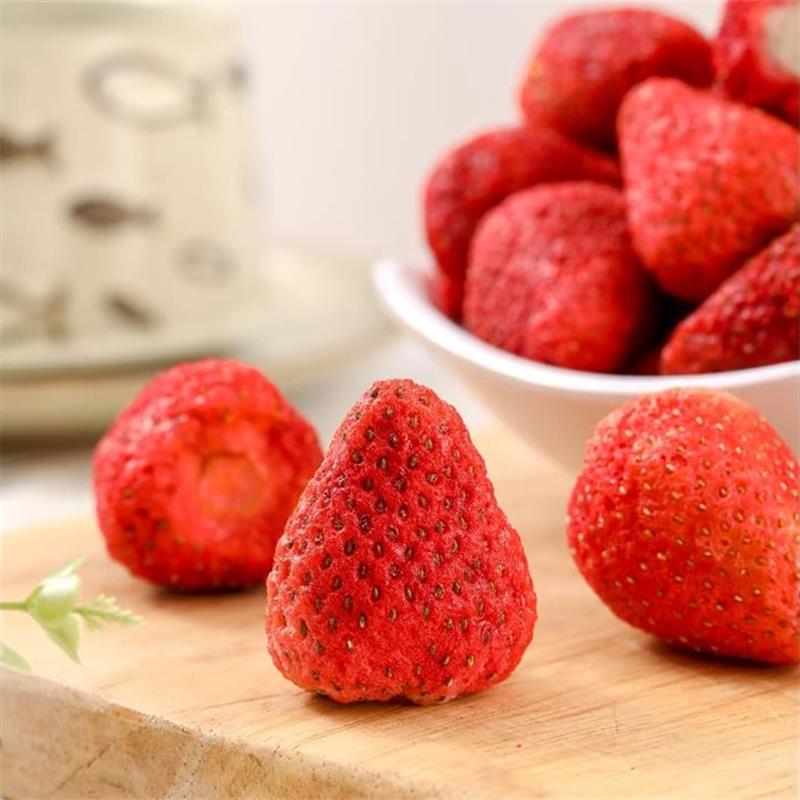
What a Professional Freeze Dried Food Manufacturer Should Provide
A good supplier does not just say yes.
They explain options. They warn buyers about trade-offs. They help prevent mistakes before production starts.
That is what buyers should look for.
Clear Product Specification
The supplier should provide a written product specification with product name, ingredient, form, moisture, shelf life, storage condition, packaging, and quality standard.
No guessing.
No vague promises.
Sample Support
Samples should match the intended bulk standard. For OEM or private label projects, buyers should approve both product sample and packaging sample before mass production.
The sample should act as the reference point for the bulk order.
Technical Communication
A serious freeze dried food manufacturer should discuss application, moisture control, packaging barrier, breakage, bulk density, storage, and documents.
The sales team does not need to sound like a laboratory manager. But they should understand the product well enough to guide a buyer.
Certifications and Documents
The supplier should prepare documents based on the buyer’s target market. Importers and distributors often need certificates, reports, product specifications, COA, and traceability support.
Documents can decide whether an order clears smoothly.
OEM and Private Label Capability
If the buyer wants a branded retail line, the supplier should support custom packaging, retail bag sizes, carton marks, label language, sample confirmation, and mixed SKU planning.
OEM work needs detail.
A good supplier knows that.
Stable Production Capacity
Freeze dried strawberries bulk orders need real production capacity. A supplier with multiple freeze-drying lines, export experience, and quality control systems can usually support larger buyers better.
Capacity does not only mean big numbers.
It means repeatable quality.
Responsive Communication
Fast communication matters in food sourcing.
Buyers manage launch dates, retailer deadlines, shipping schedules, and document requests. They need answers quickly. They need corrections quickly. They need updates before small delays become big problems.
A slow supplier creates stress.
A responsive supplier creates trust.
Practical Buying Workflow for Importers and Brands
Here is a practical workflow buyers can use.
Step 1: Define the Target Product
Write the goal clearly.
Example:
“We need freeze dried sliced strawberries for a private label cereal line in 50g retail pouch and 10kg bulk carton options.”
Or:
“We need powdered strawberry for a beverage powder formula with strong color, clean flavor, and good flowability.”
A clear target helps the supplier quote correctly.
Step 2: Request Product Options
Ask for whole, sliced, diced, and powder options if you still need to compare forms. Request photos, specifications, packaging details, certificates, MOQ, and sample availability.
Step 3: Test Samples
Test appearance, crunch, aroma, flavor, breakage, powder flow, rehydration, and formula performance based on your application.
Do not stop after one quick tasting.
Test under real use conditions.
Step 4: Confirm Documents
Ask for certificates and product documents early. Do not wait until shipment week.
Late document checks create panic.
Step 5: Approve Packaging
For retail packaging, confirm bag material, dimensions, print design, zipper, seal, desiccant, and carton loading. For bulk, confirm inner bag, carton size, net weight, and pallet plan.
Packaging approval deserves real attention.
Step 6: Confirm Commercial Terms
Confirm MOQ, price, payment terms, lead time, shipment method, mixed SKU policy, and inspection plan.
Write everything down.
Clear terms reduce conflict.
Step 7: Place Trial Order
A trial order helps both sides test product quality, packing, documents, and communication. If the supplier supports mixed SKUs, the buyer can test several products in one shipment.
That gives better market feedback.
Step 8: Review Arrival Quality
After arrival, check carton condition, seal integrity, product texture, broken rate, aroma, color, and documents.
Share feedback with the supplier. Good feedback improves the next shipment.
Why Freeze Dried Strawberry Works Well in Global Markets
Freeze Dried Strawberry solves several problems at once.
It gives color.
It gives crunch.
It gives flavor.
It stays light.
It supports retail and bulk channels.
It works as a snack and as an ingredient.
That is why buyers search for Freeze Dried Strawberry, dried strawberries, freeze dried strawberries bulk, freeze dried sliced strawberries, freeze dried whole strawberries, powdered strawberry, and related Freeze Dried Food terms.
Different buyers use different words.
Snack brands may search for private label freeze dried fruit. Cereal buyers may search for dried strawberries or strawberry inclusions. Beverage brands may search for powdered strawberry. Distributors may search for freeze dried strawberries bulk. A freeze dried meals manufacturer may search for stable fruit ingredients for breakfast and dessert mixes.
The demand spreads across regions too.
In North America and Europe, brands use this product in natural snacks, cereal, bakery, yogurt, baby food, and wellness categories. In the Middle East, HALAL support can matter. In Southeast Asia, snack and beverage innovation creates new fruit ingredient demand. In e-commerce, lightweight premium snacks ship well when suppliers use strong moisture-protective packaging.
That flexibility gives Freeze Dried Strawberry a strong role inside the global Freeze Dried Food market.
Product FAQ
1. What is the difference between Freeze Dried Strawberry and ordinary dried strawberries?
Freeze Dried Strawberry uses a low-temperature vacuum freeze-drying process. The process removes frozen water from the strawberry and helps keep a crisp texture, bright color, and strong fruit flavor. Ordinary dried strawberries often use heat drying and may feel chewy, darker, or sweeter, depending on the process and formula.
2. Which form should I choose: whole, sliced, diced, or powdered strawberry?
Choose based on application. Use freeze dried whole strawberries for premium snack packs and visual display. Use freeze dried sliced strawberries for cereal, granola, yogurt, bakery decoration, and trail mix. Use diced pieces for blending and portion control. Use powdered strawberry for beverage powders, bakery mixes, dairy, confectionery, frosting, and flavor systems.
3. Can I order freeze dried strawberries bulk for private label or OEM projects?
Yes. B2B buyers can usually request freeze dried strawberries bulk packaging for food manufacturing or retail private label packaging for branded products. Common options include custom pouches, resealable foil bags, 5kg cartons, 10kg cartons, and customized packaging based on order requirements.
4. How should Freeze Dried Strawberry be stored?
Store Freeze Dried Strawberry in a cool, dry place at normal temperature. Keep the package sealed and protect the product from moisture. After opening, close the bag tightly or transfer the product to an airtight container. Powdered strawberry needs extra moisture protection because it can clump quickly.
5. What should importers check before placing a bulk order?
Importers should check product form, ingredient statement, moisture level, shelf life, packaging method, broken rate, certifications, COA, sample consistency, MOQ, lead time, and export documents. They should also test the product in the final application before approving mass production.
Conclusion
Freeze Dried Strawberry may look like a simple fruit product, but buyers should treat it as a serious B2B ingredient and retail opportunity.
The right product helps brands build clean-label snacks, colorful cereal, better yogurt toppings, stronger bakery formulas, natural powdered strawberry drinks, and lightweight Freeze Dried Food products. The wrong product creates soft texture, dull color, high breakage, weak flavor, label trouble, packaging complaints, and delayed launches.
