

What Makes Freeze Dried Strawberry Different?
Here‘s what many buyers overlook. Freeze drying is a physics problem more than a food science problem. You’re removing water from frozen state to vapor without passing through liquid. Sounds simple. It‘s not.
Strawberries sit at roughly 90% water content. That’s higher than many other fruits. During freezing, ice crystals form. If the freezing rate isn‘t perfectly controlled, those crystals puncture cell walls. The result? Mushy rehydrated strawberries instead of crispy ones. Your cereal topping turns into a sad little red stain.
We’ve seen it happen. A buyer specs a beautiful whole freeze dried strawberry sample—perfect color, intact shape, satisfying crunch. Then the bulk order arrives from a different supplier, and the whole batch collapses into powder during shipping. Why? Different freezing curve. Different pre-treatment. And nobody checked the rehydration ratio before signing the PO.
Freeze dried strawberry bulk buyers need to understand these variables. The fruit‘s acidity also interacts with packaging materials differently than, say, freeze-dried peach. High acid content accelerates foil degradation if your pouch lamination isn’t rated for it. We‘ve opened containers where the inner lining had started separating—not because the packaging was bad, but because the packaging was wrong for that specific fruit.
Then there’s the sugar issue. Strawberry has natural sugars that become extremely hydroscopic once freeze-dried. That means it wants to pull moisture from the air aggressively. Leave a bag of freeze dried whole strawberries open in a humid environment for an hour, and you‘ve lost the crunch permanently. No bringing it back.
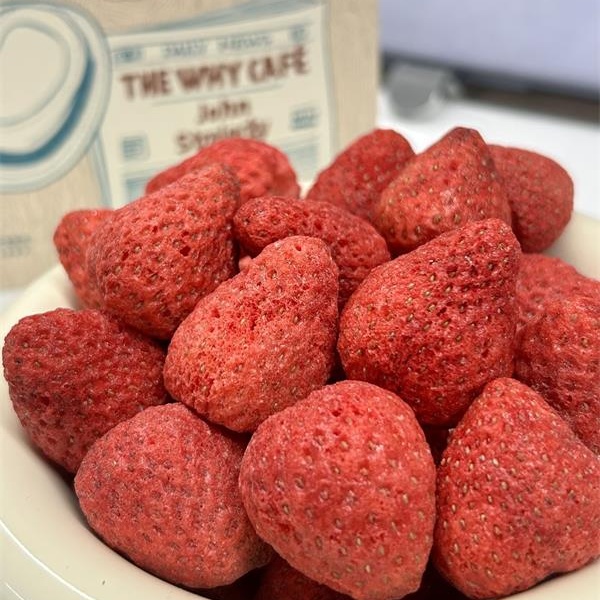
Industrial Applications: Where Freeze Dried Strawberry Actually Excels
On paper, freeze dried strawberry can go anywhere. In actual projects, though, the application environment changes everything.
Breakfast cereal manufacturing is the classic use case. Big brands incorporate freeze dried sliced strawberries into their formulations because the fruit remains shelf-stable without refrigeration and doesn’t make the cereal soggy. But here‘s the catch. The slicing thickness matters enormously. Too thin, and the pieces shatter during the cereal filling process. Too thick, and the rehydration time in milk feels weird to consumers. Our production data shows the sweet spot is 4-6mm slices for most cereal applications.
Bakery and confectionery is a different beast. Freeze dried strawberry powder has become a workhorse ingredient for natural coloring and flavoring. A single kilogram of powdered strawberry replaces about 8-10 kilograms of fresh strawberry equivalent, with none of the water dilution. That’s huge for chocolate makers and frosting formulators who don‘t want to mess with moisture balance.
We’ve seen bakery clients use freeze dried strawberry dice in muffin batters. The trick is mixing technique—if you over-mix, the dice break down and disappear. Fold gently, and you get beautiful red fruit pockets throughout the finished product.
Smoothie and beverage blends demand powder form. The particle size matters—60 mesh for instant mixability, 80 mesh for premium solubility. But here‘s where things get tricky. Some buyers specify powder without checking the bulk density. Lighter powder floats, heavier powder sinks. If your filling line runs on volumetric fillers, density variation means weight variation. You don’t want that compliance headache.
Freeze dried meals manufacturer partnerships are growing fast. Outdoor brands use whole and sliced strawberries in backpacking meal kits. The rehydration ratio—typically around 1:8 by weight—means lightweight packs deliver real fruit presence after adding water. We‘ve engineered specific moisture targets (below 3% for these applications) to ensure the fruit stays crisp through months of storage.
Nutraceutical and infant food applications require the highest quality freeze dried strawberry powder. Particle size below 100 mesh, moisture under 4%, heavy metals tested per batch. Buyers in this segment often ask for organic certification and micro-sieving to remove any seed fragments.
Real Engineering Failures We’ve Seen
We‘ve seen texture collapse happen after improper freezing rates. The strawberry comes out of the freeze dryer looking perfect. Two weeks later, it’s a sticky mess. The ice crystals were too large—the freezing step was too slow. Once the cell walls rupture, there‘s no fixing it.
We’ve seen moisture creep happen during international shipping. The product passed QC at the factory—moisture content at 4.2%, well within spec. But the shipping container sat on a dock in humid Southeast Asia for three weeks. Temperature cycling caused condensation inside the bulk bags. The entire shipment arrived soft and clumped. Now we require nitrogen-flushed inner liners for any sea freight exceeding 15 days.
We’ve seen color fading happen when UV exposure hit retail packaging. Clear pouches look beautiful on shelf. But strawberry‘s anthocyanins are photosensitive. Three months under supermarket lighting, and that vivid red turns dull brown-pink. Buyers who skip light-barrier testing learn this the hard way.
We’ve seen contamination issues when factories run strawberry after other products without thorough line cleaning. Strawberry’s acidity can leach residual flavors from previous runs. A batch of strawberry shouldn‘t taste like the onion that ran two shifts ago. But we’ve witnessed it.
We‘ve seen rehydration failures that traced back to pre-treatment chemicals. Some manufacturers dip strawberries in calcium solutions before freeze-drying to maintain firmness. Works fine for whole fruit applications. But for powder destined for instant beverages, those same calcium additives can cause clouding and sedimentation. The buyer assumed all freeze dried strawberry powder was interchangeable. It’s not.
Honestly, this is where many buyers get confused. They look at two suppliers‘ spec sheets—same moisture range, same packaging weight, same price point. The products look identical on paper. In real production, they‘re worlds apart. The difference is in the process parameters nobody writes down.
Manufacturing Capabilities: What 29 Production Lines Actually Mean
Our Zhangzhou facility runs 29 advanced freeze-drying production lines. But let me translate what that number actually means for buyers.
Twenty-nine lines give us something smaller factories can’t offer: lot-to-lot consistency through continuous operation. When you‘re running 24/7, the process parameters stabilize. The freezing curves become repeatable. The vacuum pressure holds steady. A small factory that freeze-dries strawberries twice a month is essentially recalibrating every time they start up. That’s risk.
The annual output of 10,000 tons across all products means raw material throughput is massive. Fresh strawberries arrive in season, get processed quickly, and the freeze-drying happens before degradation sets in. Timing is everything. The window between harvest and frozen storage directly impacts final color retention. Shorter window, brighter red.
We maintain over 50 R&D staff in bioengineering and food science. That‘s not marketing fluff. That’s people who run failure analysis when something goes wrong. Who track moisture data across seasons and strawberry varieties. Who understand that the Australian strawberry behaves differently than the Chinese one in the freeze dryer.
Certifications include HACCP, BRC, HALAL, KOSHER, and organic. For freeze dried strawberry bulk shipments to Europe or North America, BRC certification is increasingly non-negotiable. Retailers won‘t even start the vendor approval process without it.
Packaging Engineering: More Important Than You Think
Packaging for freeze dried strawberry is not simple.
The enemy is moisture. Always. But also oxygen. And light. And physical impact.
Our standard bulk packaging uses sealed plastic inner bags inside sturdy cardboard cartons. The inner bag gets nitrogen flushing before sealing. Why nitrogen? Because oxygen accelerates degradation of both color and flavor. Nitrogen is inert—it pushes oxygen out and creates a protective atmosphere.
For retail packaging, we offer resealable foil pouches with moisture absorbent packs. This is critical. Even a high-quality pouch will get opened and closed many times in a consumer‘s kitchen. The moisture absorbent pack buys them extra time after that first seal break.
One thing we’ve learned: shipping weight calculations for freeze dried strawberries need to account for volume, not just mass. A full container of freeze dried whole strawberries weighs significantly less than a container of fresh strawberries, but takes up the same space. Buyers who don‘t understand this get surprised by freight costs. Freeze dried fruit has big volume and low weight—shipping companies count freight by volume.
Shelf life hits 18 months under proper storage—temperature below 25°C, humidity below 50%. That’s industry standard for properly processed product. If a supplier claims 24 months without additional packaging technology, ask questions.
Buyer Requirements: What to Ask Before Signing
Let me walk through what experienced freeze dried food manufacturer buyers actually check.
First, request batch-specific Certificates of Analysis (CoA). Don‘t accept a generic spec sheet. You want moisture content, water activity, and microbiological counts for the specific batch you’re buying. Moisture should be below 5%—our spec is 5% max. Water activity below 0.30 aw. Anything higher risks mold during shipping and storage.
Second, ask about the freezing process. What‘s the freezing rate? How long from fresh to frozen? What’s the target ice crystal size? A supplier who can‘t answer these questions probably isn’t controlling the process tightly.
Third, understand the pre-treatment. Are they using any anti-oxidants? Calcium dips? Citric acid washes? These aren‘t necessarily bad—but they affect how the final product behaves in your application.
Fourth, test the rehydration ratio yourself. Take a sample. Add water. Wait five minutes. Does it look like fresh strawberry? Or does it turn into slime? The best freeze dried strawberry rehydrates to about 80% of fresh texture and appearance.
Fifth, verify packaging compatibility with your shipping route. Sea freight to Europe vs. air freight to Japan—different humidity exposures, different durations, different packaging needs. Don’t assume one packaging solution fits all destinations.
Sixth, understand the supplier‘s supply chain location. Facilities near strawberry orchards get fresher raw material, which directly impacts final product quality. Our Zhangzhou location is positioned within Fujian Province‘s agricultural region.
Seventh, MOQ matters. Our standard bulk order minimum is a 20GP container, with mixed SKUs allowed (3-4 product types in one container for trial orders). That’s relatively buyer-friendly for first-time partners. Many freeze dried strawberries bulk suppliers require full containers of single products.
Product Specifications Reference
Here‘s what you’ll typically find in freeze dried strawberry specifications from established manufacturers:
| Parameter | Typical Range |
|---|---|
| Moisture content | 5% max |
| Water activity (aw) | ≤ 0.30 |
| Shelf life | 18-24 months |
| Available forms | Whole, slice, dice, powder |
| Powder mesh size | 60 mesh, 80 mesh |
| Dice sizes | 3x3mm, 5x5mm, 10x10mm, 15x15mm |
| Slice thickness | 4-6mm for cereal applications |
| Packaging bulk | 5kg/box, 10kg/box, or 15kg/box |
| Packaging retail | 20g, 30g, 50g, 100g resealable pouches |
| Storage temp | Normal room temperature, < 25°C |
| Storage humidity | < 50% RH |
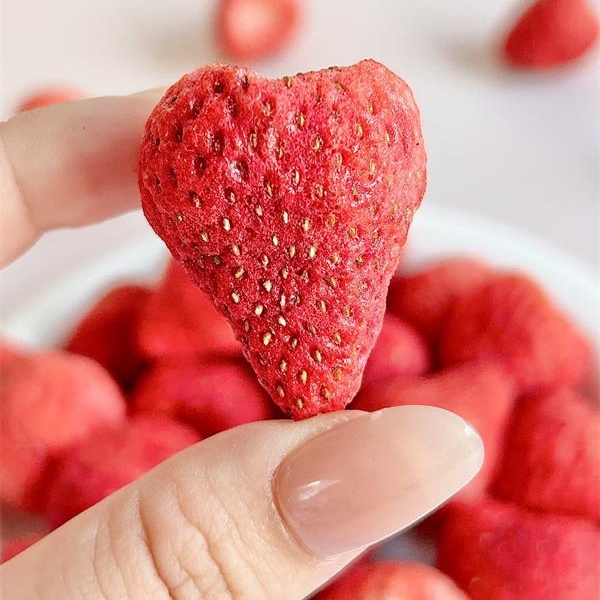
Freeze dried strawberry powder typically runs at 4-5% moisture for food-grade applications. For nutraceutical or premium applications, some buyers request under 4%. The lower the moisture, the longer the shelf stability, but also the higher the production cost and fragility.
Particle size standardization is another spec to watch. For diced formats, 3-5mm and 5-7mm are common industrial sizes. Consistency in sizing affects everything from visual appeal to rehydration uniformity.
The OEM Difference
Here‘s something that separates real freeze dried food manufacturer operations from trading companies.
We offer OEM and ODM customization. That means we don’t just pack bulk product into generic boxes. We develop custom specifications for your brand. Sugar-free options. Organic certifications. Custom blends with other freeze dried fruits. Specific particle size distributions. Unique packaging formats.
A trading company buys finished product from a factory and resells it. That‘s fine for standard commodities. But if you need a specific sugar level, a unique blend ratio, or packaging with your brand artwork, you need a manufacturer with OEM capabilities.
Our brand name CrispPuer covers our standard product line, but the same production lines can run your specifications. The flexibility comes from controlling the process from raw material to finished bag.
FAQ
Q1: What‘s the difference between freeze dried strawberries and regular dried strawberries?
Freeze drying uses low temperature and vacuum to remove water directly from frozen state. Regular drying uses heat. The result? Freeze dried keeps the original shape, color, and most nutrients. Air-dried turns chewy and darker. Freeze dried strawberry crunch is unmistakable. Regular dried strawberry is more like fruit leather texture.
Q2: How long do freeze dried strawberries really last?
Properly stored—cool, dry, sealed container—18 months is standard from date of manufacture. Some premium packaging can push to 24 months. Once opened, eat within a week or the moisture in the air will destroy the crispness.
Q3: Can I get freeze dried strawberry powder that’s completely sugar-free?
Yes. 100% pure strawberry with no added sugar is the standard offering from most manufacturers. But verify the label—some suppliers add sugar as a processing aid without clearly disclosing it.
Q4: What‘s the typical MOQ for freeze dried strawberries bulk orders?
20GP container is standard, though smaller trial quantities may be negotiable. Many manufacturers allow mixing 3-4 different SKUs in one container for trial orders. That means you can test whole, sliced, and powder in one shipment.
Q5: How should I store bulk freeze dried strawberry inventory?
Keep in original sealed packaging until use. Store in a clean, dry warehouse. Temperature below 25°C, humidity below 50%. Once you open a bulk inner bag, repurpose the contents quickly or transfer to airtight containers with desiccant packs.
Q6: Are freeze dried strawberries as nutritious as fresh?
Close. The freeze-drying process preserves most vitamins and minerals. Some vitamin C loss occurs during processing, but far less than heat drying methods. The fiber content remains intact. What you lose is water volume—by weight, freeze dried is more nutrient-dense than fresh.
Q7: What certifications should I look for in a freeze dried strawberry supplier?
HACCP is baseline. BRC or equivalent GFSI-recognized certification for export to major retailers. HALAL and KOSHER if your market requires them. Organic certification adds cost but opens premium market channels. Check that certificates are current and cover your specific product.
Q8: Can freeze dried strawberries be used in hot applications like baking?
Yes, but with adjustments. Fold gently into batters—over-mixing breaks the pieces down. Or consider freeze dried strawberry powder for even distribution. The fruit itself won’t burn at typical baking temperatures, but extended high heat may darken the color.
Q9: What‘s the rehydration ratio for freeze dried whole strawberries?
Typically around 1:8 to 1:10 by weight. One gram of freeze dried strawberry rehydrates to about eight grams of water-reconstituted fruit. The exact ratio depends on the freeze-drying process parameters and the original fruit density.
Q10: How do I verify moisture content before buying?
Request batch-specific Certificates of Analysis from the supplier. For critical applications, send a sample to an independent lab for verification before committing to large freeze dried strawberries bulk orders. Most reputable suppliers welcome this step—it shows you’re serious about quality.
