

The market has shifted — and most buyers haven't caught up
Five years ago, we mostly heard from granola companies and trail mix brands when it came to bulk dried strawberries. That's still a big segment. But the inquiries we get now? Yogurt manufacturers in Southeast Asia. Supplement brands in the US that want real strawberry powder instead of "natural strawberry flavor." Infant food producers in Europe. Camping meal kit companies building out their SKU range.
What changed isn't the product. It's the buyer.
Clean labels are no longer a niche positioning — they're a baseline expectation in most consumer markets. When shoppers flip a package over and read "strawberry, sugar, citric acid, artificial color" they put it back. Freeze dried food made from 100% whole fruit sidesteps all of that. One ingredient. That's the pitch, and it works.
Shelf stability is the other thing. For any brand doing international distribution — especially into markets with unreliable cold chain infrastructure — a product that holds 18 months at ambient temperature isn't a nice-to-have. It changes the whole logistics model.
How freeze drying actually works
Three stages. First, the fresh strawberries are frozen hard. Then the chamber goes into a deep vacuum and the temperature is carefully managed so the ice converts straight to vapor — it skips the liquid phase entirely. That's sublimation. Last stage pulls out any remaining bound moisture.
The result: the berry holds its shape. The anthocyanins that give strawberries that bright red stay intact. Vitamin C — which is destroyed by heat drying — survives. The flavor is more intense than fresh because you're concentrating it, not cooking it.
Compare that to conventional hot-air drying. Heat collapses the cell structure. Color turns brownish. The texture goes leathery. And the rehydration is messy — hot-air dried fruit doesn't reconstitute cleanly, it just softens unevenly. For ingredient applications, that matters a lot.
Whole, sliced, diced, or powder — the format question matters more than most buyers expect
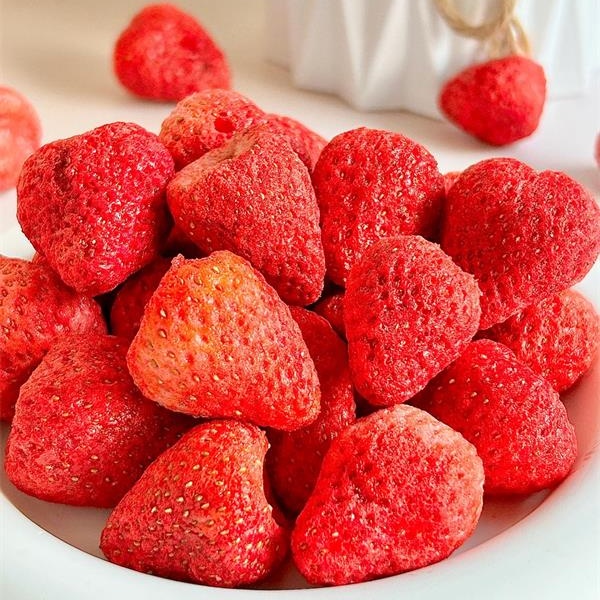
Freeze dried whole strawberries are what retail brands typically want. The shape is intact, the color is photogenic, and they rehydrate in a predictable way. For cereal toppers, premium granola, and high-end trail mixes, whole berries are the spec. One thing buyers don't always think about: whole berries are more fragile to handle and ship. They need gentler bulk packaging to arrive without crumbling.
Freeze dried sliced strawberries are where most ingredient supply goes. Bakeries, confectionery companies, yogurt toppings. For baking specifically, slice thickness consistency matters more than people realize. We had a confectionery customer come to us after switching suppliers — their previous source had slices ranging from 2mm to 8mm in the same batch. In a muffin, the thin ones disappear and the thick ones don't rehydrate fully by bake time. When they moved to our controlled 3–5mm thickness, the problem went away.
Powdered strawberry opens up a completely different application set: protein powders, smoothie mixes, ice cream bases, beverage flavoring. We've supplied freeze-dried strawberry powder to a Korean skincare brand that used it in face mask formulations. The surface area is much larger in powder form, which means it's far more hygroscopic and oxidizes faster. Packaging requirements are stricter — vacuum-sealed inner bags, not just resealable foil pouches.
Honestly, the format decision should happen before the supplier conversation, not after. A lot of buyers come in asking for "freeze dried strawberries" without specifying form, and then the sample they receive doesn't match what they actually need.
Product specs — the numbers that matter
| Parameter | Specification |
|---|---|
| Product Name | Freeze Dried Strawberry |
| Ingredient | 100% Pure Strawberry |
| Forms Available | Whole / Slice / Dice / Powder |
| Moisture | ≤5% Max |
| Shelf Life | 18 months (room temperature, sealed) |
| Retail Bag Sizes | 20g, 30g, 50g, 100g — or custom |
| Bulk Pack | 5kg/box, 10kg/box — or custom |
| Certifications | HACCP, BRC, HALAL, KOSHER, Organic |
| Grade | Premium |
The moisture spec is the one to watch. ≤5% is where you need to be. We've tested product from other suppliers that passed QC at 7–8% moisture — looks fine in the bag, feels crisp when you open it. But within two or three weeks of opening, it softens and starts clumping. That's when the customer complaints come in. By that point, the buyer has already shipped product to retail.
Where things go wrong — actual problems we've seen
This is the part that most supplier pages don't talk about.
Moisture creeping in during ocean freight. We've seen condensation issues develop inside bulk cartons on routes through Southeast Asian ports during monsoon season. The product is fine when it leaves the factory. The problem happens mid-transit when the container temperature fluctuates. The fix isn't better raw material — it's the packaging engineering. A standard 10kg bulk carton needs a properly sized desiccant, usually 50g silica gel at minimum, not the 10g packet that some factories throw in because it's cheaper.
Color going brownish on retail shelves. Freeze dried whole strawberries packed in transparent PET bags look good in the sample. Six months on a supermarket shelf under fluorescent lighting? The anthocyanins oxidize and the color shifts toward brown-pink. High-barrier foil pouches with oxygen absorbers are the solution. Clear packaging doesn't protect the color regardless of how well it seals.
Powdered strawberry arriving fine, clumping in the warehouse. We've seen full pallets of strawberry powder arrive at a Malaysian warehouse in perfect condition, then turn into solid blocks after three weeks of storage without climate control. The powder is extremely hygroscopic — it will pull moisture out of the air through packaging that isn't airtight. Vacuum-sealed inner bags are not optional for powder format. And the buyer's warehouse team needs to understand the storage requirements, not just the procurement team.
Rehydration problems in manufacturing. A yogurt brand running a parfait line came to us after their previous freeze-dried strawberry slices were creating uneven texture in the finished product. Some slices were fully softened, others still crispy. The thickness variation in their old supply was causing it. Consistent slice cut — which comes from controlled processing, not just a good specification document — is what solves it.
Who's actually buying freeze dried strawberries in bulk
Cereal and granola manufacturers are the largest consistent buyer segment. Monthly volumes of 5–10 tons for a mid-sized cereal operation aren't unusual. The trend we've seen is brands moving away from broken or irregular pieces and specifying premium whole berries, because the visual in the bowl now drives social media content and packaging photography.
Protein and supplement companies want powdered strawberry specifically. The market for naturally flavored protein powders has grown a lot, and brands that can say "flavored with real strawberry" instead of "strawberry flavor" command a price premium. Volume per SKU is lower than food manufacturing, but quality requirements — particle size, color index, flavor intensity — are tighter.
Freeze dried meals manufacturers — the camping food and emergency preparedness segment — use freeze dried strawberries as a breakfast meal component, standalone snack, or dessert element. There's a lot of "25-year shelf life" marketing in this category. That claim depends entirely on packaging: vacuum-sealed Mylar pouches with oxygen absorbers. The fruit itself is stable, but the wrong container and the shelf life drops to months, not decades.
D2C snack brands are the fastest-growing segment we've dealt with lately. These are brands selling freeze-dried fruit as a direct alternative to candy or chips — clean label, no added sugar, positioned as a premium snack. They care intensely about visual quality. Whole berries need to arrive uncracked and uncrumbled, which means the bulk inner packaging has to protect against vibration during shipping, not just seal in moisture.
Bakeries and chocolatiers buy sliced or diced format. Freeze-dried strawberry on white chocolate bark became a staple at some point and hasn't gone away. These buyers are often smaller volume but repeat, and they tend to be the most specific about visual consistency.
The OEM and private label conversation
A big portion of the brands sourcing freeze dried strawberries bulk aren't manufacturing themselves — they're building a label, specifying a product, and sourcing from a factory that can match the brief.
Here's how that typically works with us:
Trial orders start with a mixed container — 3 or 4 different SKUs combined in a 20GP, so a buyer can test multiple formats or pack sizes before committing to a single product at full volume. The MOQ for ongoing orders is a standard 20-foot container.
Custom packaging is common. Most retail brands want their own label, their own pouch style, sometimes specific bag colors or window configurations. OEM lead time for custom-printed packaging runs 25–30 days from confirmed artwork. Standard packaging with no custom print can move in 15 days if there's available stock.
Certification requirements vary by destination market. European buyers almost always lead with BRC. Middle Eastern and Southeast Asian buyers need HALAL. Some North American retail channels require KOSHER. Organic certification is relevant for brands positioning in that lane. All of these are held — ask for current copies, not just a list of certifications claimed on a website.
Samples ship in 7–15 days. The sample fee comes back in the first bulk order. We'd rather a buyer test the product properly before committing than have a mismatch discovered after production.
The factory behind the product
The facility has been running since 2006, based in Zhangzhou, Fujian — which is relevant because Fujian has deep agricultural networks for fruit sourcing and direct port access through Xiamen for export. The fresh-to-freeze-dryer transit time affects raw material quality in ways that don't show up on a spec sheet but do show up in the finished product flavor.
29 freeze-drying lines. Annual output across the full product range: 10,000 tons. R&D team of 50+ specialists in food science and bioengineering.
As a freeze dried food manufacturer at this scale, the production flow is standardized and each batch traceable: raw material incoming inspection → sorting and washing → pre-freezing → lyophilization → post-process quality check → packaging → final outgoing inspection.
Export markets include the US, Germany, UK, Spain, Japan, South Korea, Russia, Indonesia, Singapore, and Malaysia. The product has had to pass import requirements across all of these markets — which is part of what the certification stack (HACCP, BRC, HALAL, KOSHER, Organic) is built to support.
Packaging — the part buyers overlook until it causes a problem
The product is only as good as what surrounds it by the time it reaches the end consumer.
Retail foil pouches need appropriate barrier properties — specifically, moisture vapor transmission rate matched to the target shelf life. A cheap laminate saves a few cents per unit and causes softening complaints within months. High-barrier pouches cost more and protect the product.
Heat seal integrity matters. We've seen seal failures appear specifically after long-distance ocean shipping vibration — not a material defect, just slightly inconsistent sealing pressure on one production run. That's a process control issue, and it's exactly why seal-pull tests need to happen batch by batch, not just on initial design samples.
Desiccant sizing is not one-size-fits-all. Match the silica gel packet to the pack volume. A 50g retail bag does not need the same desiccant as a 10kg bulk carton. Over-specifying adds unnecessary cost; under-specifying causes clumping.
For bulk carton orders, inner PE liner sealed after filling plus correct compression-strength cardboard for container stacking. We've had buyers tell us their previous supplier's product arrived with crushed cartons at the bottom layer of the pallet. The product inside was technically fine. The customer relationship wasn't.
Export markets and what each one actually cares about
Different markets have different entry requirements and buyer behaviors.
North America: buyers want larger retail sizes, 100g and above. Premium whole-berry format. Organic is a real premium segment, not just a niche. Private label brands here tend to be well-organized on specification documentation.
Europe: BRC certification is the floor. German and Dutch buyers in particular are highly technical — they'll ask for full CoA documentation, lab test reports, and sometimes request third-party testing before releasing payment on the first order. Plan for that process.
Southeast Asia: HALAL is non-negotiable for most markets. Demand in urban retail is growing quickly in Indonesia, Malaysia, and Singapore. Product tends to be bought through trading companies rather than direct factory contact.
Middle East: larger order volumes typically, but the spec negotiation needs to happen carefully upfront. Buyers here often work through regional distributors. Getting the product spec and certification requirements confirmed before production is more important than in direct-buyer markets.
Japan and South Korea: extremely specific on visual quality and packaging finish. Japanese retail buyers in particular will reject product with any cosmetic defect — cracking, color variation, inconsistent sizing — that other markets would accept.
FAQ
What's the actual difference between freeze dried and air dried strawberries?
Air drying uses heat. Heat collapses the cell structure, darkens the color, destroys vitamin C, and produces a leathery texture. Freeze drying removes moisture through sublimation at low temperature — the structure stays intact, the color stays bright, and the texture is light and crispy. For rehydration applications in food manufacturing, freeze-dried reconstitutes cleanly; air-dried doesn't.
Can you bake with freeze dried strawberries without rehydrating them first?
Yes, and that's one of the main reasons the format works well in bakery applications. Add them dry — they absorb moisture from the batter during mixing and baking. In high-moisture batters, add them closer to the end of mixing so they don't start softening before the bake. For no-bake applications like chocolate coatings or yogurt toppings, they stay crisp and add texture.
Which certifications should I actually ask for, and which ones are just marketing?
HACCP is the food safety baseline — every serious supplier should have it. BRC matters for UK and EU retail channels. HALAL is an entry requirement for Muslim-majority markets. KOSHER matters for specific North American retail channels. Organic is relevant if your brand is positioned there. The key thing: always ask for the actual certificate document with the current validity date, not just a logo on a website.
How do I store a bulk pallet of freeze dried strawberries at my warehouse?
Below 25°C, humidity below 65%, no direct light, away from strong-smelling products. Freeze-dried fruit is porous — it can absorb off-flavors from nearby storage. The packaging barrier degrades faster in high-humidity environments even if the carton is sealed. Don't treat it like ambient grocery product just because it doesn't need refrigeration.
What's the MOQ and can I test multiple formats before committing?
Standard MOQ is a 20GP container. For first orders, mixing 3–4 SKUs — say, whole berries, sliced, and powder — to fill one container is common and reasonable. It lets you test market response across formats without over-committing to one product line.
What's the difference between powdered strawberry and regular freeze dried pieces?
Powder is the same product milled after freeze drying. The difference in handling is significant though. Powder has a much larger surface area, so it absorbs moisture from air very aggressively — it needs vacuum-sealed inner bags and strict storage conditions. It also oxidizes faster if exposed to air. Application-wise: powder goes into beverages, protein supplements, cosmetics, flavoring systems. Pieces go into cereals, baked goods, chocolate, and snacks.
Can I specify a strawberry variety?
For larger volumes, yes — this is worth discussing. Variety affects sugar content, color depth, and acidity. Availability varies by season and by year depending on harvest conditions. Ask early in the sourcing conversation rather than after sampling, since variety can affect what the sample represents.
What's the real lead time for OEM orders?
Custom-print OEM/ODM orders: 25–30 days from approved artwork and order confirmation. Standard packaging with available stock: as fast as 15 days. Sample shipment before bulk order: 7–15 days. Sample fee is credited back in the first bulk order.
A few things worth saying plainly before you go
Many buyers approach freeze-dried strawberry sourcing the same way they'd buy a commodity — send a spec, get a price, choose the lowest quote. That works fine for some products. For freeze dried food, it tends to produce problems later.
The moisture spec tells you something, but not everything. Packaging barrier properties, desiccant sizing, seal integrity under shipping stress — these are the variables that determine whether the product your customer opens in six months matches what left the factory. A supplier that can explain those choices is a supplier that actually understands the product.
Ask for a sample. Test it under the conditions your product will actually face — not just a quick taste test, but stored for a few weeks in the packaging you're planning to use. That's where the real differences show up.
Certifications matter, but check the dates. A HALAL certificate from three years ago may or may not reflect the current facility status.
And if a supplier can't explain why they recommend a particular desiccant size for your pack configuration, that's information too.
